WhatsApp Groups vs a Dedicated Society App: An Honest Comparison for Committees
By MyKutir Editorial Team — 2026-08-05
WhatsApp is great for chatting and terrible for running a society. This honest, balanced comparison shows where groups break down for committees and what a dedicated app adds — without pretending WhatsApp has no strengths.
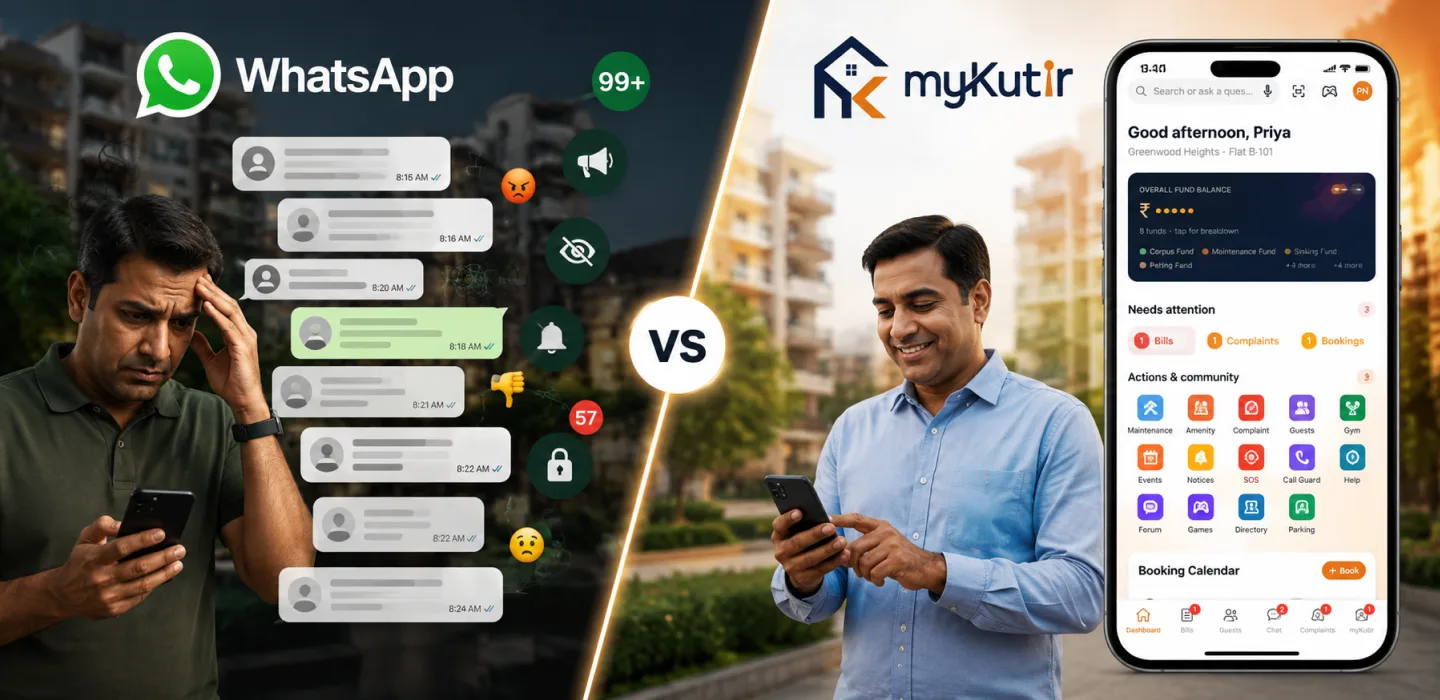
Almost every housing society in India runs its communication on WhatsApp. It is free, everyone already has it, and setting up a group takes ninety seconds. For years it has been the default nervous system of community life — announcements, complaints, arguments, birthday wishes, and the endless good-morning flowers all flowing through the same green app. So when someone suggests moving society communication to a dedicated app, the honest reaction from most committees is: why bother? WhatsApp works.
This article takes that question seriously. It is not a hit piece on WhatsApp — WhatsApp is a genuinely excellent messaging app and it will remain part of society life. Instead, it is an honest, side-by-side comparison of what WhatsApp groups do well, where they break down for the specific job of running a society, and what a purpose-built platform adds. If you are a committee weighing whether to change anything, this is the balanced view you actually need.
What WhatsApp groups genuinely do well
Let us be fair first, because pretending WhatsApp has no strengths is how you lose an audience that lives on it. WhatsApp groups are excellent at:
- Instant reach. Everyone has it installed and checks it constantly. A message is seen fast.
- Zero onboarding. No new app to download, no login, no training. Grandparents use it comfortably.
- Informal community warmth. The festival greetings, the lost-and-found, the "anyone have a spare cylinder" — this social glue is real and valuable.
- Real-time conversation. For back-and-forth chat, it is genuinely convenient.
Any honest comparison has to concede that these are not small things. The social, conversational, informal layer of community life is something WhatsApp handles beautifully, and a dedicated platform should complement it rather than pretend to replace it entirely.
Where WhatsApp groups break down for running a society
The problems start the moment WhatsApp stops being used for chatting and starts being used for managing — for official notices, complaints, records, money, and decisions. It was designed for conversation, not administration, and the gap shows in predictable ways.
1. Official announcements drown in chatter
A society posts an important notice — water supply off tomorrow, 10am to 2pm — and within minutes it is buried under twenty replies, three forwards, and a good-morning sticker. Members who check the group at 6pm scroll past it entirely. There is no separation between "official society announcement everyone must see" and "casual chat." Everything is the same grey bubble in the same stream.
A dedicated notice system solves this by making a notice a distinct, permanent object — titled, dated, non-scrollable-away, markable as urgent, and available with attachments. On MyKutir, a notice can be flagged urgent, carry file attachments, and even include a poll, and it lives in a notices section rather than a chat river. It does not compete with birthday wishes for attention. You can see the communication tools on the features page.
2. You cannot target the right people
WhatsApp is all-or-nothing. A notice relevant only to Block C, or only to ground-floor flats, or only to owners (not tenants), still goes to all 300 members — or you create a tangle of overlapping sub-groups that nobody can keep track of. Over-messaging trains people to mute the group, at which point even urgent messages are missed.
A proper platform lets you target an audience: everyone, or specific flats, or a defined group. MyKutir notices support an audience setting and can target specific flats, so the people who need a message get it and the people who do not are not spammed. Targeting is not just tidier — it is what keeps notifications meaningful enough that people still read them.
3. No record, no proof, no continuity
This is the big one. WhatsApp is ephemeral by design. Scroll up a week and the notice about the AGM is gone under thousands of messages. There is no searchable archive of society decisions, no proof that a notice was issued, and when the committee changes, the new committee inherits nothing but a chat group with no institutional memory.
For a body that makes financial and governance decisions, this is a genuine liability. A notice archive that persists, is searchable, and can be found months later is not a luxury — it is basic record-keeping. And when a platform adds semantic search over that archive (the ability to ask "what did we decide about pet rules?" and get the actual notice), the archive becomes an asset instead of a graveyard.
4. Everything important gets lost — complaints, payments, decisions
Because WhatsApp is one undifferentiated stream, everything of consequence gets lost in it. A complaint posted at 9pm is forgotten by morning. A payment confirmation photo is buried. A committee decision is un-findable. WhatsApp cannot track a complaint's status, cannot record who paid what, and cannot show whether an action was taken. It is a place where important things are mentioned, not a place where they are managed.
5. No moderation, no accountability, real conflict
Anyone who has admin'd a society group knows the dark side: heated arguments, personal attacks, misinformation, forwarded rumours, and the exhausting job of playing referee. WhatsApp gives admins almost no tools — you can remove someone, and that is about it. There is no way for a resident to quietly block another, no structured way to report objectionable content for review, no separation between official and social spaces.
A dedicated community platform can offer proper moderation — the ability for a resident to block another user so they no longer see their messages or posts, and to report content for committee review. These are not just features; they are what make a large community space civil and safe, and they matter increasingly as societies take their duty of care to residents seriously.
The multi-channel point WhatsApp cannot match
Here is something committees often miss: not everyone is reliably on WhatsApp, and for genuinely important messages, one channel is not enough. An elderly owner might respond better to an SMS; an urgent alert might warrant a push notification that cuts through; a routine reminder might go on WhatsApp. WhatsApp-only communication is single-channel by definition.
A platform with a broadcast capability can send the same message across multiple channels — SMS, WhatsApp, and app push notifications — so an important announcement reaches people the way they are most likely to see it. MyKutir's broadcast feature works across these channels, which means "did everyone get the message?" stops being a hope and becomes something closer to a guarantee. For payment reminders in particular, multi-channel delivery is dramatically more effective than a single group post everyone scrolls past.
Structured conversation, not just a firehose
One fair objection is: "but our residents like to talk, and a notice board is one-way." This is true, and a good platform does not force communication to be one-directional. Alongside official notices, a community app can offer structured social spaces — a community feed or forum where residents post, comment, run polls, and organise, but with categories, moderation, and a sense of place that a single flat chat river lacks.
MyKutir includes both directed notices (with optional polls attached) and community social features — forum-style posts with polls and events, and group chat — so the warmth and back-and-forth of community life has a home too. The difference from WhatsApp is that this conversation is organised, moderatable, and separate from official announcements, rather than all mashed into one stream. You can explore the broader community tooling on the community management page.
The honest counterpoints against switching
A genuinely balanced comparison has to give the other side its due. Here are the real reasons a committee might hesitate, and honest responses:
- "Residents won't adopt a new app." This is the biggest real risk. The answer is not to abolish WhatsApp overnight but to move the administrative functions — notices, complaints, payments, records — to the platform while letting casual chat stay wherever residents are comfortable. Adoption follows utility: people install the app when it is the only place to pay their bill or track their complaint.
- "WhatsApp is free." True, but "free" ignores the cost of lost complaints, missed payments, disputes, and the committee's time spent refereeing. The relevant question is total cost, not sticker price.
- "Older residents struggle with new apps." A fair concern. This is exactly why multi-channel matters — an older resident can receive SMS reminders and printed-style notices without living inside the app, while the record still exists digitally.
- "We've always used WhatsApp." Habit is powerful, but it is not a reason. The question is whether the current setup actually serves the society's administrative needs — and for most, the honest answer is that it serves chatting well and managing badly.
Side-by-side comparison
| Function | WhatsApp group | Dedicated society app |
|---|---|---|
| Casual chat & social warmth | Excellent | Good (structured feed/chat) |
| Onboarding effort | None | Requires adoption |
| Official notices | Lost in the stream | Distinct, permanent, urgent-flaggable |
| Targeting an audience | All-or-nothing | By flat, block, or group |
| Searchable archive | None | Persistent, searchable notices |
| Complaint tracking | Impossible | Ticketed with status |
| Multi-channel delivery | Single channel | SMS + WhatsApp + push |
| Moderation tools | Minimal (remove only) | Block, report, review |
| Institutional memory | Lost on committee change | Persists across committees |
A short illustrative scenario
The following is a made-up illustration, not real data.
Take "Palm Grove," a society that ran everything on three overlapping WhatsApp groups. When they needed to announce an emergency water shutdown, the admin posted in all three groups. In the first, it was buried under a debate about visitor parking. In the second, half the members had muted the group months ago after being spammed. In the third, an elderly owner who rarely opens WhatsApp missed it entirely and was caught without stored water. When a resident's complaint about a sewage smell went into the same groups, it got two sympathetic replies and then vanished — nobody owned it, and a week later it was as if it had never been raised.
After moving administrative communication to a platform, the same shutdown went out as an urgent notice targeted to the affected blocks, delivered across push, SMS, and WhatsApp, and it stayed visible in the notices section instead of scrolling away. The elderly owner got the SMS. The complaint became a tracked ticket with an owner. The casual chatter, meanwhile, stayed on WhatsApp, because nobody was trying to abolish community warmth — just to stop official business from drowning in it.
The pragmatic recommendation
The honest conclusion is not "delete WhatsApp." It is a division of labour:
- Keep casual, social, real-time chatter wherever residents are already comfortable, including WhatsApp.
- Move the administrative functions — official notices, targeted announcements, complaints, payments, records, and moderation — to a purpose-built platform that can actually manage them.
- Use multi-channel broadcast for anything genuinely important, so no one misses it because they were not looking at one particular app.
WhatsApp is a wonderful place to chat and a terrible place to run a society. Recognising that distinction — and matching each job to the right tool — is what a mature committee does. If you want to see how the administrative side is handled, the how it works page walks through it, and you can reach out via the contact page with specifics about your society.
Frequently asked questions
Do we have to stop using WhatsApp entirely?
No, and you probably should not. WhatsApp is excellent for casual, social, real-time chatter, and residents are comfortable with it. The recommendation is to move only the administrative functions — official notices, complaints, payments, records — to a dedicated platform, while letting informal community conversation stay where it already lives.
Won't residents refuse to adopt a new app?
Adoption is the real risk, and it follows utility. When the app is the only place to pay maintenance, track a complaint, or see official notices, residents install it because it is useful, not because they were told to. Trying to force social chat onto the app is what fails; moving genuine administrative value onto it is what works.
How is a notice different from a WhatsApp message?
A notice is a distinct, permanent object — titled, dated, markable as urgent, able to carry attachments and polls, and targetable to specific flats or groups — that lives in a dedicated section instead of a chat stream. It does not scroll away under chatter, and it remains searchable months later, which a WhatsApp message does not.
What does multi-channel broadcast mean?
It means the same message can be sent across SMS, WhatsApp, and app push notifications at once, so it reaches people through whichever channel they actually check. For important announcements and payment reminders, this dramatically improves the odds that everyone genuinely receives the message, compared with a single group post.
How does moderation work better than on WhatsApp?
A dedicated platform can let a resident block another user so they no longer see their messages or posts, and report objectionable content for committee review. WhatsApp gives admins little beyond removing someone from the group. Proper moderation tools are what keep a large community space civil and safe.
What about elderly residents who struggle with apps?
This is exactly where multi-channel delivery helps — an older resident can receive important messages by SMS without living inside the app, while the digital record still exists for everyone else. The platform serves the society's record-keeping needs without forcing every individual to change how they personally prefer to receive messages.
Can residents still have conversations, or is it just one-way notices?
A good community platform includes structured social spaces — a feed or forum with posts, polls, and events, plus group chat — so two-way conversation has a home. The difference from WhatsApp is that it is organised, moderatable, and kept separate from official announcements, rather than everything sharing one stream.
Key takeaways
- WhatsApp is genuinely excellent at casual chat, instant reach, and community warmth — a fair comparison concedes this.
- It breaks down for managing a society: official notices drown, you cannot target audiences, there is no searchable record, and important items get lost.
- A dedicated platform makes notices distinct, permanent, urgent-flaggable, targetable to specific flats, and searchable long after posting.
- Multi-channel broadcast across SMS, WhatsApp, and push reaches people the way they actually check messages — something WhatsApp-only cannot do.
- Proper moderation (block and report) keeps a large community civil in a way WhatsApp's remove-only admin tools cannot.
- The honest recommendation is a division of labour: keep casual chatter on WhatsApp, move administration to a purpose-built platform.
- Adoption follows utility — residents install the app when it is where they pay, complain, and get official information, not because they were told to.