Enhancing Visitor Security in Housing Societies: A Security Guide
By Amit Khetariya — 2026-09-25
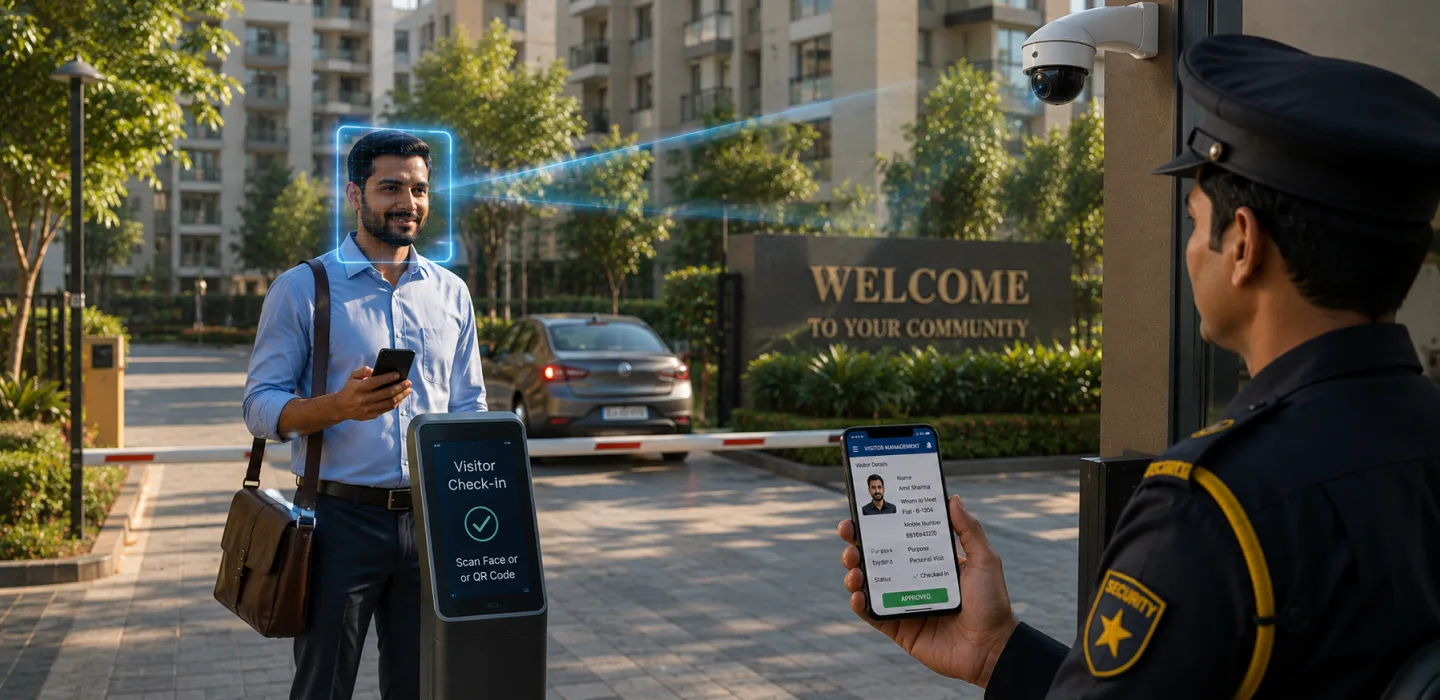
Visitor security is about letting the right people in quickly and keeping a reliable record of everyone who enters.
In short: visitor security is about letting the right people in quickly and keeping a reliable record of everyone who enters. This security guide covers myKutir's visitor management system, how it strengthens security, a day at the gate, common mistakes, a comparison and steps to implement it.
Overview of myKutir's visitor management
- Residents approve visitors from their phones.
- Guest passes, one-time, multi-day or repeating, shared as QR codes or PINs.
- Parcels logged, with residents notified.
- Domestic workers recorded, with verification status and face recognition.
- A searchable visitor log across all gates.
See myKutir's visitor management system.
How does it strengthen security?
- Resident consent: nobody enters on the guard's guess.
- Enforced limits: passes have time windows and entry limits, checked the same way whether scanned, typed or matched by name.
- No double use: two gates can't both admit someone on the last entry of a pass.
- Reachability: if nobody in the flat can be reached, the guard is told to call. Residents without the app get an SMS.
- ID handling: only the last four characters of an ID are stored.
- Overstay alerts: the host flat is told when a visitor stays too long, with limits by visitor type.
- Revocation: residents can cancel passes, even used ones.
Scenario: a day in the life of a security guard
An illustrative example. At 9 am, a plumber arrives on a one-time pass. The guard scans it and logs the entry. At 11 am, a courier's parcel is logged and held at the gate. At 2 pm, an unexpected visitor asks for flat D-502. The guard logs the visit, and the resident approves from work. At 6 pm, a cab driver has been inside for 40 minutes, and an overstay alert reaches the host flat and the guards on duty.
Common mistakes in visitor security
- Letting visitors in on a resident's verbal word through the intercom without logging them.
- Long-lasting passes used as permanent access.
- Full ID numbers written in open registers.
- Different practices at different gates.
Digital or traditional visitor security?
| Area | Traditional | Digital |
|---|---|---|
| Approval | Intercom call | Phone approval or pass |
| Limits | None | Time window and entries |
| ID | Full number in a register | Last four characters only |
| Overstays | Unnoticed | Alerts |
Steps to implement effective visitor security
- Agree on rules: ID checks, pass types and overstay limits by visitor type.
- Register residents and domestic workers.
- Equip and test each gate.
- Train guards on every shift.
- Tell residents how to approve visitors and share passes.
- Review the visitor log monthly.
Frequently asked questions
Can overstay limits differ for cabs and guests?
Yes. Limits can be set separately for guests, deliveries, cabs and service visits.
What if the internet is down?
Keep a short paper fallback and enter those visits once the connection returns.
Conclusion
Digital visitor management makes gates both faster and safer, with residents in control. For privacy considerations, read balancing security and privacy.
Key takeaways
- Residents approve every visitor, or the visitor has a valid pass.
- Passes have limits that can't be bypassed.
- Store only partial ID numbers.
- Use overstay alerts and review the log.