Preventing Common Mistakes in Maintenance Billing for Housing Societies
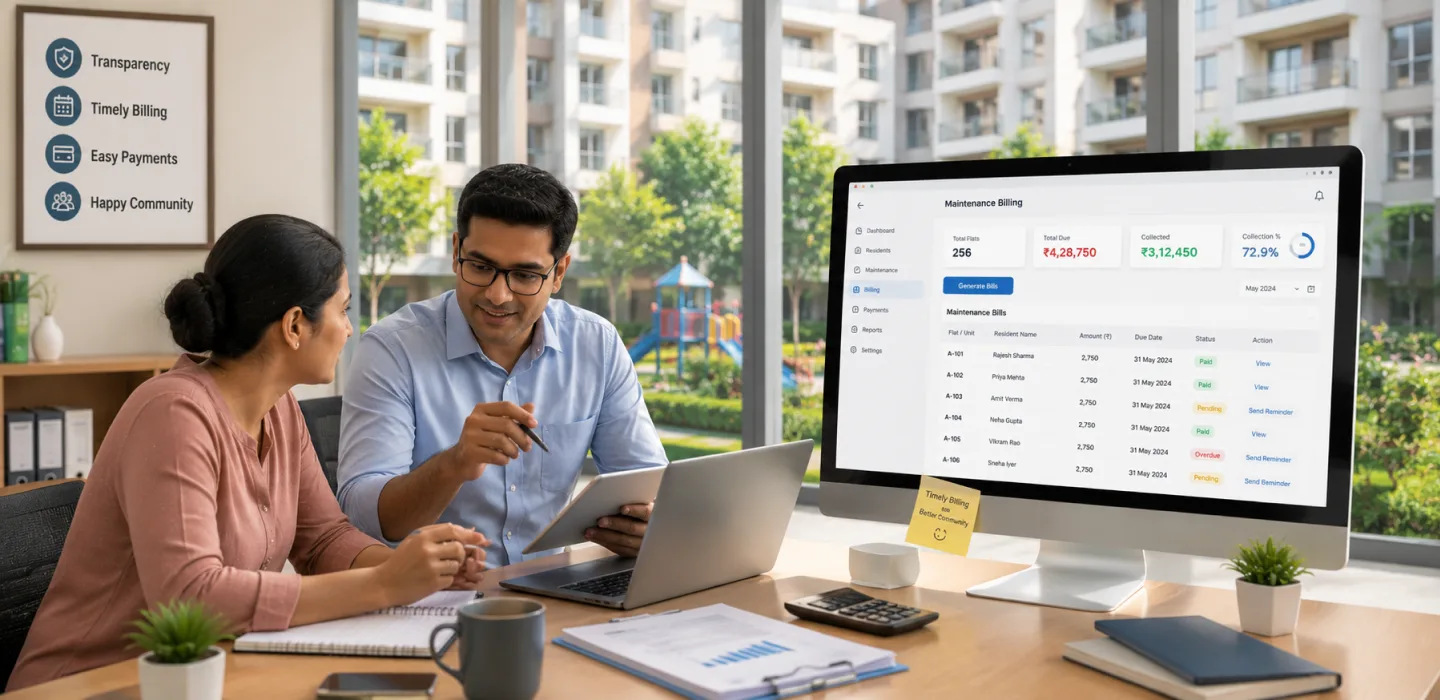
By MyKutir Editorial Team — 2026-09-12
Explore common pitfalls in maintenance billing for housing societies and learn how to avoid them with practical strategies.
In the realm of housing societies, accurate maintenance billing isn't just a financial obligation; it's a pillar of operational harmony. Effective maintenance billing ensures that society management can sustainably cover ongoing expenses while maintaining transparency and trust with residents. When billing is handled with precision, residents are more likely to feel satisfied with the services provided, supporting a positive community atmosphere. Conversely, errors in maintenance billing can lead to disputes, erode trust, and create significant administrative burdens.
Disputes often arise when residents receive unexpected charges or inaccurate bills. For instance, if a resident receives a bill that is higher than anticipated due to incorrect calculations, they may contest the charge, leading to prolonged negotiations and possibly delayed payments. This not only affects the cash flow of the society but also strains relationships between residents and the management committee. Moreover, frequent billing errors can tarnish the reputation of the society's management, resulting in a lack of confidence from residents.
From an administrative perspective, rectifying billing mistakes is time-consuming and resource-intensive. The management team must backtrack through records, identify the source of errors, and issue corrected bills. This process can detract from other essential management activities, such as facility upkeep and community planning. Furthermore, if billing errors lead to funding shortfalls, vital maintenance and improvement projects could be delayed or underfunded, affecting the quality of communal facilities.
Financial stability is another critical reason why accurate maintenance billing is essential. Housing societies operate on a budget that relies heavily on timely and correct maintenance fee collection. Errors in billing can distort the society's financial planning and budgeting, potentially leading to cash flow issues. These financial missteps can hinder the society’s ability to pay for utilities, repairs, and other necessary services, ultimately impacting all residents.
Therefore, implementing a robust system for maintenance billing, with proper checks and balances, is crucial for the smooth operation of any housing society. It not only prevents disputes and administrative headaches but also ensures that the society remains financially sound. This foundation of trust and transparency fosters a more harmonious living environment for all residents.
Common Maintenance Billing Mistakes
Billing inaccuracies in housing societies are more common than one might expect, often stemming from manual errors, oversight, or lack of updated systems. Identifying these errors is vital in preventing long-term issues and ensuring both the society's financial health and resident satisfaction.
One prevalent mistake is the incorrect calculation of maintenance charges. This can happen when different formulas or bases are applied inconsistently across units. For example, if some residents are charged based on flat size while others are billed a flat rate, discrepancies can occur. Such inconsistencies can lead to residents feeling unfairly treated, causing dissatisfaction and disputes.
Missing bills are another common issue. This might result from administrative oversight or technical glitches, especially in societies relying on manual record-keeping. Residents who do not receive their bills on time might face challenges in budgeting their finances, leading to delayed payments and potential penalties, further complicating financial management for both the resident and the society.
Applying and managing late payment penalties is another area prone to errors. Societies often set penalties for overdue payments to encourage timely collections. However, if these penalties are not consistently applied or are calculated incorrectly, it can lead to confusion and dissatisfaction among residents. For instance, if some residents notice that they have been charged penalties inconsistently, it can lead to claims of unfair treatment and bias.
GST application is a particularly sensitive area where errors frequently occur. Given the complexities of tax laws and varying thresholds, determining when and how much GST to apply to maintenance bills can be challenging. Misapplication, either through oversight or misunderstanding of the regulations, can lead to legal repercussions and financial penalties for the society.
Each of these mistakes highlights the importance of having a reliable maintenance billing system. By being aware of these common pitfalls, housing societies can take proactive steps to avoid them, ensuring smooth operations and fostering trust among residents.
How MyKutir Helps Avoid These Mistakes
MyKutir offers a suite of features designed specifically to address and mitigate common maintenance billing errors, making it an invaluable tool for housing society management. By leveraging technology, MyKutir streamlines the entire billing process, reducing the likelihood of human error and enhancing transparency and efficiency.
One of the standout features of MyKutir is its automated billing cycles. Unlike traditional manual methods which are prone to errors and inconsistencies, MyKutir automates the entire billing process from start to finish. This means that bills are generated and distributed on time, every time, minimizing the risk of missed or delayed bills. Automated cycles also ensure that each unit is billed according to the correct parameters, whether based on area, flat rate, or any other agreed measure, thus preventing discrepancies.
MyKutir's precise calculation tools are another asset in preventing billing errors. These tools are programmed to accurately apply rates and penalties as configured, eliminating calculation errors that can arise from manual inputs. For instance, late payment penalties are automatically applied according to predefined rules, ensuring consistency and fairness across all residents. This not only enhances operational efficiency but also helps to maintain trust and transparency within the community.
Additionally, MyKutir integrates seamlessly with Razorpay for streamlined payment tracking and management. This integration allows residents to pay their bills online through a secure gateway, ensuring timely payments. The system automatically updates payment records, reducing administrative burdens and providing up-to-date financial information to society management. This reduces the scope for disputes and ensures that society accounts are always accurate and transparent.
These features can be further explored in detail through the MyKutir platform. For housing societies looking to modernize and improve their maintenance billing processes, investing in a robust solution like MyKutir can lead to significant reductions in errors and administrative workloads, thus enhancing the overall living experience for residents.
For more details on the features of MyKutir, visit the maintenance billing software page.
Scenario: Correcting a Billing Error
Consider a hypothetical scenario where a billing error in a housing society is discovered. A resident, Mr. Sharma, notices an unusual increase in his monthly maintenance bill. On examining the detailed bill, he identifies that a late payment penalty has been incorrectly applied, even though he had cleared his previous dues on time.
Understanding the gravity of the situation, Mr. Sharma promptly contacts the society management. The management team, aware of the potential for such errors, takes immediate action. They first review the payment records available on the MyKutir platform. Thanks to the Razorpay integration, they can easily access real-time payment histories, which confirm Mr. Sharma's timely payment.
Upon identifying the error in penalty application, the management uses MyKutir's precise calculation tools to correct the mistake. They adjust the amount and reissue a corrected bill to Mr. Sharma with an apology for the oversight. This rectification process is swift thanks to the automated features of MyKutir, which streamline the generation of corrected bills.
To prevent similar issues in the future, the management reviews their billing configurations within MyKutir. They check the rules for penalty application, ensuring they align with the society's policies. Additionally, they decide to conduct a brief training session for their administrative staff on how to use MyKutir's features more effectively.
Communication is also key in this scenario. The management sends out a notice to all residents acknowledging the error, explaining the steps taken to rectify it, and reassuring them of the measures put in place to prevent future occurrences. This transparent approach helps in maintaining trust and goodwill among the residents.
This scenario illustrates the importance of having a robust system like MyKutir that not only helps in identifying and correcting errors quickly but also supports proactive measures to enhance billing accuracy and resident satisfaction.
Comparison: Manual Billing vs. Automated Billing Systems
When it comes to maintenance billing in housing societies, the choice between manual billing methods and automated systems like MyKutir is a significant one. The differences in efficiency, error rates, and ease of use are stark and can greatly impact the society's financial health and resident satisfaction. Below is a comparison table highlighting these differences:
| Aspect | Manual Billing (e.g., Excel Sheets) | Automated Billing (e.g., MyKutir) |
|---|---|---|
| Error Rates | High, due to manual entry and calculation errors | Low, as processes are automated and consistent |
| Efficiency | Time-consuming, requires substantial human intervention | Time-efficient, processes are streamlined and automated |
| Ease of Use | Complex, requires understanding of spreadsheets and formulas | User-friendly, with intuitive interfaces and guidance |
| Customizability | Limited, hard to implement complex rules | Highly customizable, supports complex billing rules and configurations |
| Transparency | Low, harder to track changes and updates | High, all records are updated in real-time and easily accessible |
| Scalability | Limited, difficult to scale without significant manual effort | Highly scalable, handles increased data and complexity effortlessly |
From the table, it's evident that automated systems like MyKutir offer significant advantages over manual billing methods. Not only do they reduce the likelihood of errors and save time, but they also provide a much more transparent and user-friendly experience. This can lead to greater resident satisfaction and more efficient society management.
Societies still using manual billing might find the transition to an automated system requires an initial investment of time and resources. However, the long-term benefits in terms of efficiency, accuracy, and scalability far outweigh these initial efforts.
Step-by-Step Guide to Implementing an Effective Billing System
Implementing an efficient maintenance billing system using MyKutir can significantly enhance the operational efficiency of a housing society. Here is a detailed guide on setting up such a system:
- Initial Setup: Begin by setting up your society's account on MyKutir. Ensure that all necessary details about the society, including building names, unit numbers, and resident information, are accurately entered into the system.
- Configuring Billing Rates: Define the billing parameters based on your society's needs. This could include charges based on flat size, flat rates, or any other predefined criteria. MyKutir allows for precise configuration of these rates to ensure fairness and consistency.
- Setting Billing Cycles: Determine the frequency of your billing cycles—monthly, quarterly, or annually. MyKutir enables automated generation and distribution of bills based on these cycles, which reduces manual work and ensures timely collection.
- Integrating Payment Gateways: To facilitate seamless payment collection, integrate a payment gateway like Razorpay with MyKutir. This integration allows residents to pay their bills online securely, enhancing convenience and improving payment timelines.
- Testing and Training: Before fully rolling out the system, conduct a test run to ensure all configurations work as expected. It is also beneficial to train staff on using MyKutir effectively, focusing on key features such as bill generation, payment tracking, and error correction.
- Go Live and Monitor: Once the system is set up and tested, go live with your first billing cycle. Monitor the process closely, being ready to address any issues that arise. Use MyKutir’s analytics to track payments and identify any areas for improvement.
- Regular Audits: Periodically audit the billing system to ensure accuracy and compliance with any regulatory changes. MyKutir facilitates easy auditing by maintaining a comprehensive record of all transactions and adjustments.
By following these steps, housing societies can implement a robust billing system that not only reduces errors and administrative burdens but also enhances the overall satisfaction of the residents. This approach ensures that maintenance billing is handled efficiently and transparently, fostering a harmonious living environment.
Avoiding Errors: Best Practices for Maintenance Billing
Implementing best practices in maintenance billing is crucial to minimizing errors and ensuring a smooth operation for housing societies. Here are some effective strategies to enhance billing accuracy and efficiency:
- Regular Audits: Conduct regular audits of billing records and processes to identify discrepancies early. This proactive approach can help catch errors before they become significant issues.
- Clear Communication: Maintain open and transparent communication with residents about billing policies, charges, and due dates. Providing clear explanations can prevent misunderstandings and disputes.
- Staff Training: Ensure that all staff involved in the billing process are thoroughly trained on the use of billing software and understand the society’s billing policies. Regular training sessions can keep them updated on new features and best practices.
- Use of Technology: Leverage technology such as MyKutir to automate and streamline billing processes. Automated systems reduce the likelihood of errors and ensure consistent application of billing rules.
- Feedback Mechanism: Establish a mechanism for residents to provide feedback on billing processes. This can help identify common issues and areas for improvement, enhancing overall satisfaction.
- Documented Processes: Have clear, documented processes for billing, adjustments, and dispute resolution. This documentation serves as a reference for staff and residents alike, reducing confusion and ensuring consistency.
By adopting these best practices, housing societies can significantly reduce billing errors, leading to more efficient operations and satisfied residents. The key is to be proactive, transparent, and open to continuous improvement.
Frequently Asked Questions About Maintenance Billing
What are some common mistakes in maintenance billing?
Common mistakes in maintenance billing include incorrect calculation of charges, where different units may not be billed consistently, leading to disputes among residents. Missing bills can occur due to administrative oversight or system errors, causing delays in payments. Errors in applying late payment penalties or misapplication of GST can also arise due to complexity in tax laws and oversight, all of which can lead to financial and reputational issues for the society.
How can technology help prevent billing errors?
Technology, such as the MyKutir system, can significantly mitigate billing errors by automating the entire process. Automated systems reduce the reliance on manual input, which is prone to human error. They ensure consistent application of billing rules across all units, streamline the generation and distribution of bills, and integrate seamlessly with payment systems for accurate tracking and recording. Additionally, technology provides robust analytics and reporting tools that help society management preemptively identify and correct potential issues.
What should be done if a billing error is discovered?
If a billing error is discovered, it is crucial to address it promptly. The first step is to verify the error by cross-checking records. Once confirmed, communicate with the affected resident to explain the mistake and the corrective action being taken. Use billing software like MyKutir to adjust and reissue the correct bill efficiently. Finally, review the processes that led to the error to prevent future occurrences, and inform the community about the steps taken to rectify the issue to maintain transparency and trust.
How does GST apply to maintenance billing?
GST application in maintenance billing can be complex, as it depends on several factors including the nature of services provided and turnover thresholds, which vary by state and over time. Societies may be required to apply GST to maintenance charges if they cross certain revenue thresholds. It is essential for societies to stay informed about relevant GST regulations and consult with a chartered accountant to ensure compliance. Accurate application of GST is crucial to avoid legal issues and financial penalties.
What are the benefits of automated billing systems?
Automated billing systems, like MyKutir, offer numerous benefits over manual methods. They reduce human error, ensure consistent application of billing rules, and streamline the entire billing process—from generation to payment collection. Automated systems save time, improve transparency, and enhance resident satisfaction by ensuring accurate and timely billing. They also provide valuable insights through comprehensive reports and analytics, enabling proactive management of the society's financials.
Conclusion: Ensuring Accurate and Efficient Maintenance Billing
Accurate and efficient maintenance billing is a cornerstone of successful housing society management. By avoiding common billing mistakes and adopting systematic processes bolstered by technology, societies can enhance their operational efficiency and foster a harmonious community atmosphere.
The implementation of automated billing systems such as MyKutir plays a pivotal role in minimizing human errors, improving accuracy, and enhancing transparency. Such systems provide a seamless way to manage billing cycles, apply appropriate charges, and ensure timely collections, all of which contribute to the society's financial stability and the residents' satisfaction.
It is essential for society management to remain proactive in auditing their billing processes, providing adequate training to staff, and maintaining clear communication with residents. These actions not only prevent errors but also build trust and confidence within the community.
Ultimately, by leveraging technology and adhering to best practices, housing societies can manage their maintenance billing processes more effectively, ensuring a well-functioning, content, and cooperative residential community.
Key Takeaways
- Accurate maintenance billing is crucial for financial stability and resident satisfaction.
- Common billing mistakes include incorrect charge calculations, missing bills, and GST errors.
- MyKutir offers automated features that reduce errors and streamline billing processes.
- Implementing a robust billing system involves clear communication, regular audits, and proper technology use.
- Automated systems like MyKutir improve accuracy, efficiency, and transparency compared to manual methods.