Problem→Solution in Effective Maintenance Billing for Housing Societies
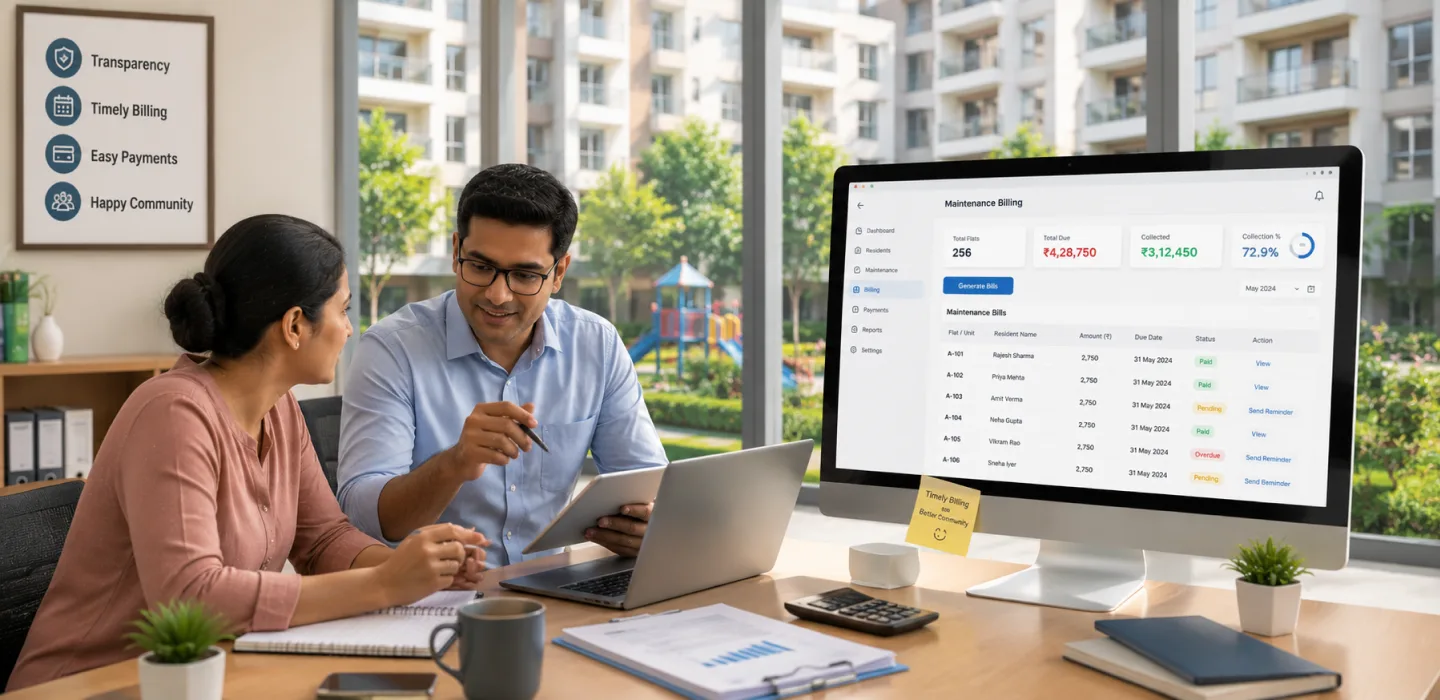
By MyKutir Editorial Team — 2026-09-21
Explore practical solutions to common maintenance billing challenges faced by housing societies.
Maintenance billing in housing societies is a vital component of financial management that ensures the smooth operation and sustainability of the community. However, several challenges can hinder the effectiveness of this process. Incorrect billing, delayed payments, and inefficient record-keeping are typical issues that housing societies encounter. These challenges not only create administrative burdens but also affect the trust and satisfaction of residents.
Incorrect billing is a common issue stemming from human error, especially in societies that rely on manual systems or outdated software. When bills do not accurately reflect the services rendered or the agreed-upon rates, it can lead to disputes and non-payment, further complicating the financial health of the society. Moreover, these inaccuracies can erode trust among residents, who may feel they are not being treated fairly.
Delayed payments are another significant challenge. Many societies struggle with residents not paying their maintenance fees on time, which can disrupt cash flow and delay essential services and repairs. Without timely payments, the society might face difficulties in managing day-to-day operations, let alone planning for future upgrades or amenities.
Inefficient record-keeping compounds these issues. Without a structured system for tracking payments, expenses, and other financial data, societies can lose vital information or make data entry errors. This inefficiency can make it difficult to conduct audits, create reports, or respond to queries from residents about their billing status.
These challenges underscore the importance of addressing maintenance billing issues to ensure effective financial management. Societies must adopt a more systematic approach to billing to maintain transparency and efficiency. This involves employing technologies and strategies that streamline processes, reduce errors, and enhance communication with residents. Only by addressing these challenges can societies hope to achieve the financial stability required for their long-term success.
Understanding Maintenance Billing Challenges
Maintenance billing challenges in housing societies are multifaceted and can result in significant operational inefficiencies. Understanding these challenges is the first step toward developing effective solutions. Incorrect billing, for example, is a pervasive issue often caused by human error in manual systems. When board members or managers calculate bills manually, the risk of mistakes increases, leading to inaccurate charges for the residents. These errors can cause residents to lose trust in the management's ability to handle finances effectively.
Delayed payments are another common challenge. Many societies rely on traditional methods of payment collection, such as cash or cheques, which are not only time-consuming but also prone to delays. This can result in cash flow issues, hindering the society's ability to perform necessary maintenance and improvements. Moreover, the lack of a structured follow-up mechanism for overdue payments exacerbates this issue, leaving societies in a perpetual state of financial uncertainty.
Inefficient record-keeping is closely tied to these challenges. In the absence of a digital system, maintaining accurate records requires significant manual input, which is not only labor-intensive but also prone to errors. When records are inaccurate or incomplete, it becomes challenging to track payment histories, conduct audits, or generate financial reports, all of which are crucial for transparent financial management.
The importance of addressing these maintenance billing challenges cannot be overstated. Efficient billing practices not only ensure smooth financial management but also enhance the overall satisfaction of the residents. Societies that successfully tackle these challenges are better positioned to maintain a harmonious living environment and invest in community improvements. With the right solutions and strategies, societies can transform maintenance billing from a cumbersome task into a streamlined process that supports their long-term goals.
The Role of Technology in Streamlining Billing Processes
Technology plays a pivotal role in overcoming the maintenance billing challenges faced by housing societies. Digital platforms like MyKutir offer a comprehensive suite of features designed to streamline billing processes, enhance accuracy, and improve payment efficiency. By automating key tasks, MyKutir reduces the reliance on manual input, thereby minimizing errors and freeing up time for management to focus on other critical aspects of community management.
One of the core features of MyKutir is the ability to automate invoices. Automated invoicing ensures that residents receive their bills on time, every time. This not only enhances the predictability of cash flow but also reduces the administrative burden of manually preparing and distributing invoices. By automating this process, societies can ensure that billing is consistent and timely, helping to foster trust and transparency with residents.
Reminders are another powerful feature offered by MyKutir’s platform. By sending automated reminders to residents about upcoming due dates or overdue payments, societies can significantly reduce the incidence of late payments. These reminders can be customized to suit the society's unique requirements, whether through SMS, email, or app notifications, helping to ensure that residents remain informed and engaged with their financial obligations.
Online payments further streamline the billing process by providing residents with a convenient and flexible payment method. MyKutir supports multiple payment gateways, allowing residents to pay their bills from anywhere, at any time. This flexibility not only makes it easier for residents to stay current on their payments but also reduces the time and effort required for societies to process and track these transactions.
For more detailed information on how MyKutir can enhance billing efficiency, interested societies can explore the specific features of the platform on the maintenance billing software page. By leveraging technology, societies can make significant strides in overcoming billing challenges, creating a more efficient, transparent, and resident-friendly financial management system.
Common Mistakes in Maintenance Billing
In the day-to-day operations of housing societies, several common mistakes can arise in maintenance billing that can significantly affect the community's financial health. Recognizing these errors is essential for societies aiming to improve their billing processes and enhance resident satisfaction.
Manual calculation mistakes are a widespread issue in societies that still rely on paper-based systems or simple spreadsheets. Such systems are inherently prone to human error due to factors like miscalculations, data entry errors, or misinterpretation of financial data. These mistakes can lead to incorrect bills, which not only frustrate residents but may also result in delayed payments or disputes.
Outdated billing systems further compound these issues. Societies using antiquated software or manual processes often find themselves lagging in efficiency. Outdated systems might not support convenient features like online payments or automated reminders, making it challenging to keep pace with modern demands for quick and efficient transactions. This can lead to slow processing times, missed payments, and an overall lack of transparency in financial operations.
A lack of clarity in bill statements is another common pitfall. Residents need to understand what they are being billed for, yet often, bill statements are not detailed enough to provide this clarity. Insufficiently itemized bills can lead to confusion and mistrust among residents who may question the legitimacy of the charges. Detailed and clear billing statements are crucial for maintaining trust and ensuring compliance with legal standards for transparency.
These common mistakes highlight the importance of adopting more robust billing systems and practices. By identifying and addressing these errors, societies can improve their financial processes, enhance resident trust, and avoid the administrative burdens that arise from disputes and delayed payments. Ultimately, societies that invest in efficient billing solutions position themselves better for sustainable community management and growth.
Implementing Efficient Record-Keeping Practices
Efficient record-keeping is the backbone of effective maintenance billing in housing societies. Without accurate and up-to-date records, societies face numerous challenges, ranging from financial discrepancies to inefficiencies in reporting and auditing. By implementing best practices in record-keeping, societies can enhance their financial transparency and management capabilities.
Integrating digital solutions is a crucial step toward efficient record-keeping. Platforms like MyKutir offer automated record updates, ensuring that every transaction is accurately captured and logged. This automation minimizes the risk of human error and ensures consistency across all financial documents. With digital records, societies can easily access and update information, facilitating timely audits and robust financial reporting.
Data loss is a significant risk for societies relying on paper-based systems or outdated software. Physical records are susceptible to damage, loss, or misplacement, leading to incomplete financial histories. Digital solutions mitigate these risks by providing secure cloud storage options, where records are safely backed up and protected against data breaches or physical damage.
Regular audits and reviews are essential components of effective record-keeping. Societies should establish routine checks to ensure that financial transactions are accurately recorded and that records align with actual financial activities. These audits help identify discrepancies early, allowing for corrective measures before issues escalate. Regular reviews also improve the society's ability to generate detailed financial reports, essential for transparency and strategic planning.
By adopting these best practices, housing societies can significantly enhance their record-keeping efficiency. This not only improves the overall quality of financial management but also builds trust with residents. Accurate and transparent records provide a solid foundation for all financial activities and support the society's long-term financial stability and growth.
Strategies for Timely Payment Collection
Ensuring timely payment collection is a critical component of maintaining the financial health of housing societies. Late payments can disrupt cash flow, delay maintenance projects, and lead to increased administrative burdens. Implementing effective strategies for payment collection can help societies mitigate these issues and maintain smooth operations.
One effective strategy is offering early-bird discounts. By incentivizing residents to pay their maintenance fees ahead of the due date, societies can improve cash flow and reduce the incidence of late payments. These discounts not only encourage prompt payments but also foster goodwill among residents, who appreciate the financial savings and the proactive approach of the society.
Late payment fees are another strategy to encourage timely payments. By imposing a financial penalty on overdue accounts, societies can incentivize residents to pay on time and discourage habitual late payments. Clear communication about these fees and their enforcement is crucial to ensure residents understand the consequences of delayed payments and are motivated to avoid them.
Personalized reminders have proven effective in reducing payment delays. Platforms like MyKutir offer automated reminder features that can be customized to suit the needs of the society and its residents. These reminders can be sent through email, SMS, or app notifications, ensuring that residents are aware of upcoming due dates and the consequences of late payments. Personalized reminders can also be tailored to address specific residents, further enhancing their effectiveness.
Using MyKutir, societies can streamline the management of payment collections with its comprehensive tracking features. These tools allow societies to monitor payments in real-time, identify overdue accounts, and implement targeted follow-up actions. By leveraging technology, societies can enhance their payment collection processes, ensuring consistency, transparency, and efficiency.
Scenario: Resolving a Billing Dispute
Billing disputes are not uncommon in housing societies, and resolving them efficiently is crucial to maintaining resident satisfaction and trust. Let's explore a hypothetical scenario in which a society manager uses MyKutir to resolve a billing dispute with a resident.
Imagine a resident named Mr. Sharma who receives his maintenance bill and notices an unexpected charge for a service he believes he did not receive. Concerned, Mr. Sharma contacts the society office to dispute the charge. The society manager, Ms. Kapoor, accesses MyKutir's platform to address the issue efficiently.
The first step Ms. Kapoor takes is accessing the billing history through MyKutir. By reviewing Mr. Sharma's previous bills and payment history, she can verify the consistency and accuracy of charges. MyKutir's detailed records make it easy to trace the origins of the charge and verify whether it was applied correctly.
Next, Ms. Kapoor generates a report using MyKutir's reporting feature. This report outlines the specific charges in question and includes detailed explanations for each line item. With this report, she can provide Mr. Sharma with a transparent breakdown of his bill, helping to clarify any misunderstandings.
To facilitate communication, Ms. Kapoor uses MyKutir's platform to send a detailed message to Mr. Sharma, attaching the generated report. Through this message, she addresses his concerns, provides context for the disputed charge, and offers to meet with him to discuss any remaining questions.
Having received the report and explanation, Mr. Sharma reviews the information and realizes the charge was indeed for a service he had agreed to but forgotten. Grateful for the transparency and efficiency of the process, he thanks Ms. Kapoor and promptly pays his outstanding bill.
This scenario demonstrates how MyKutir's comprehensive features enable societies to resolve billing disputes effectively. By providing detailed records, customizable reports, and efficient communication tools, MyKutir supports societies in maintaining transparency and trust with their residents.
Digital vs. Manual Billing Approaches
As housing societies seek to optimize their maintenance billing processes, comparing digital and manual billing approaches reveals significant advantages to adopting a digital system. The table below outlines the key differences between these two approaches.
| Aspect | Digital Billing | Manual Billing |
|---|---|---|
| Error Reduction | Automated calculations minimize human error | Prone to miscalculations and data entry errors |
| Efficiency | Automated workflows save time and reduce administrative burdens | Time-consuming processes with manual handling and paperwork |
| Payment Tracking | Real-time tracking and automated reminders | Manual follow-up required, leading to potential delays |
| Record-Keeping | Secure cloud storage with easy access and backups | Physical records vulnerable to loss and damage |
| Resident Communication | Integrated messaging and notification systems | Manual communication prone to delays and miscommunication |
The efficiency of digital billing systems is evident in their ability to automate routine tasks, reducing the likelihood of errors that are all too common in manual systems. By streamlining workflows, digital systems free up significant time for society managers, allowing them to focus on more strategic initiatives rather than administrative tasks.
Another key advantage is the ability to track payments in real-time. Digital systems like MyKutir provide societies with up-to-the-minute data on payment statuses, overdue accounts, and upcoming due dates. This level of visibility is difficult to achieve with manual billing, where tracking often relies on periodic manual updates and checks.
Record-keeping is also vastly improved with digital systems. Secure cloud storage ensures that records are safely backed up and easily accessible, negating the risks associated with paper-based records. This is particularly important for historical financial data, audit trails, and compliance with legal obligations.
Digital systems also enable more effective communication with residents through integrated messaging and notification features. By delivering timely reminders and updates directly to residents, societies can improve engagement and reduce the incidence of late payments, which are often due to miscommunication or oversight.
As the table illustrates, transitioning to a digital billing system offers societies significant benefits in terms of efficiency, accuracy, and overall financial management. Societies that embrace digital solutions are better positioned to meet the demands of modern residents and ensure sustainable financial health.
Steps to Transition to a Digital Billing System
Transitioning from a manual to a digital billing system can seem daunting, but with careful planning and execution, societies can achieve a smooth and successful transition. Here is a step-by-step guide to help societies navigate this process.
Step 1: Evaluate Current Systems
The first step is to assess the current billing system in place. Societies should identify existing challenges, inefficiencies, and pain points. This evaluation helps pinpoint areas that require improvement and informs the selection of a suitable digital solution.
Step 2: Define Requirements
Based on the evaluation, societies should outline their specific requirements for a digital billing system. Considerations may include ease of use, integration capabilities, cost, and support for automated reminders and online payments. These requirements will guide the selection of appropriate software.
Step 3: Choose the Right Software
With defined requirements, societies can begin researching available digital billing solutions. It is essential to select a platform that meets the society's unique needs, such as MyKutir, which offers a range of features designed to enhance billing efficiency and transparency.
Step 4: Plan the Transition
Once a software platform is chosen, societies should develop a comprehensive transition plan. This plan should outline the timeline for implementation, data migration strategies, and any necessary changes to existing processes. Clear communication with all stakeholders is vital to manage expectations and encourage buy-in.
Step 5: Train Staff and Residents
Training is crucial for a successful transition. Societies should invest in training sessions for both staff and residents to ensure everyone is comfortable using the new system. Training materials, workshops, and support resources can aid in this process, helping users understand the system's features and benefits.
Step 6: Implement the System
With training completed, societies can begin implementing the digital billing system. This step involves setting up the software, migrating existing data, and configuring the system to align with established billing practices. It is beneficial to have IT support available to address any technical issues that arise during implementation.
Step 7: Monitor and Adjust
After implementation, societies should actively monitor the system's performance to ensure it meets expectations. Feedback from staff and residents can provide valuable insights for ongoing adjustments and improvements. Regular reviews ensure the system continues to align with the society's evolving needs.
By following these steps, societies can successfully transition to a digital billing system, unlocking significant improvements in efficiency, accuracy, and financial management. Embracing digital solutions not only benefits the society's internal operations but also enhances the resident experience, fostering a more cohesive and financially sustainable community.
FAQs on Maintenance Billing in Housing Societies
What are the common challenges in maintenance billing for housing societies?
Common challenges in maintenance billing include incorrect billing due to manual errors, delayed payments, and inefficient record-keeping. These issues can stem from outdated systems that require significant manual input, leading to human errors and time-consuming processes. Such challenges affect not only the financial health of societies but also their reputation among residents, who may lose trust due to billing inaccuracies or a lack of transparency. Addressing these issues through efficient systems and practices is crucial for maintaining a positive relationship with residents and ensuring the society's financial stability.
How can technology assist in making maintenance billing more efficient?
Technology plays a significant role in enhancing maintenance billing efficiency by automating routine tasks and reducing manual errors. Digital platforms, like MyKutir, offer features such as automated invoicing, real-time payment tracking, and personalized reminders, which streamline processes and improve accuracy. These systems facilitate easier communication with residents and provide secure data storage, making financial management more transparent and reliable. By leveraging technology, housing societies can improve their billing processes, enhance resident satisfaction, and maintain better financial control.
What are the risks of manual billing processes?
Manual billing processes pose several risks, including a higher likelihood of errors due to manual calculations and data entries. Such errors can result in incorrect billing, disputes, and delayed payments. Manual systems are also time-consuming, requiring significant administrative effort to prepare bills, track payments, and manage records. Furthermore, physical records are susceptible to loss or damage, which can compromise data integrity and hinder efforts to conduct audits or generate reports. These risks highlight the importance of moving to digital systems, which offer greater accuracy, efficiency, and security.
How does MyKutir enhance maintenance billing for societies?
MyKutir enhances maintenance billing by providing a suite of digital tools designed to streamline financial processes. Key features include automated invoicing, which ensures timely and consistent billing, and real-time payment tracking, which offers immediate insights into financial transactions. MyKutir also supports multiple payment gateways, allowing residents to pay their bills online, thereby reducing late payments. Additionally, MyKutir's platform includes advanced communication tools that facilitate efficient interaction with residents, addressing queries and disputes effectively. These features contribute to a more efficient, transparent, and resident-friendly billing process.
What strategies can be used to encourage timely payments?
To encourage timely payments, societies can implement several strategies, such as offering early-bird discounts to incentivize prompt payment and imposing late payment fees to discourage delays. Automated reminders are also effective, as they keep residents informed of due dates and outstanding balances. Digital platforms like MyKutir can automate these reminders, ensuring consistent and personalized communication. By combining these strategies, societies can improve their cash flow, reduce administrative burdens, and foster a more financially responsible resident community.
How can societies handle billing disputes effectively?
Handling billing disputes effectively requires a structured approach that prioritizes transparency and communication. Societies should provide residents with clear and detailed billing statements to minimize misunderstandings. When disputes arise, platforms like MyKutir can aid in quickly accessing billing histories and generating comprehensive reports to clarify charges. Open communication channels, facilitated by MyKutir's messaging tools, help address resident concerns promptly and professionally. By resolving disputes efficiently, societies can maintain trust and ensure continued resident satisfaction.
What are the steps for transitioning to a digital billing system?
Transitioning to a digital billing system involves several key steps: evaluating current systems to identify pain points, defining specific requirements for digital solutions, and selecting appropriate software. Once a platform like MyKutir is chosen, societies should plan the transition carefully, including data migration and process changes. Training staff and residents is crucial to ensure comfort and competence with the new system. Post-implementation, continuous monitoring and adjustment help societies optimize their digital billing processes. These steps ensure a smooth transition, unlocking significant improvements in efficiency and financial management.
Key Takeaways
- Maintenance billing challenges such as incorrect billing and delayed payments can hinder housing societies' financial management.
- Digital platforms like MyKutir streamline billing processes through automation, reducing errors and enhancing efficiency.
- Common mistakes in billing include manual errors and outdated systems, underscoring the need for robust digital solutions.
- Efficient record-keeping practices are crucial for accurate billing and include integrating digital solutions for secure data management.
- Strategies such as early-bird discounts and personalized reminders support timely payment collection and improved cash flow.
- Billing disputes can be resolved effectively using digital tools like MyKutir, which offers detailed records and communication solutions.
- Transitioning to a digital billing system involves careful planning, adequate training, and ongoing monitoring for successful implementation.