Housing Society Management Software: The Complete 2026 Guide
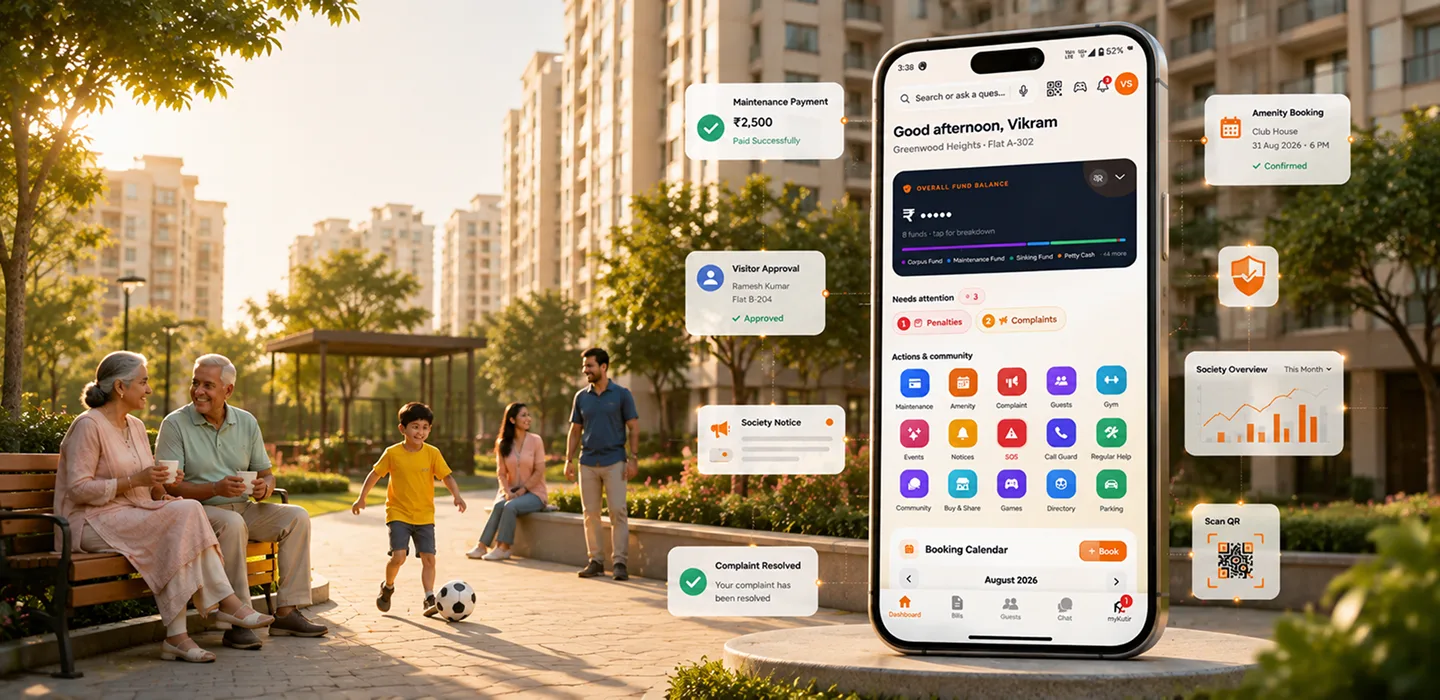
By MyKutir Editorial Team — 2026-08-02
A practical, no-fluff guide for Indian RWAs and apartment associations evaluating society management software -- what it actually replaces, which features matter, the GST/audit angle, and how to choose without drowning in feature lists.
Every housing society treasurer has had this moment: it's the night before the AGM, the maintenance register doesn't tally with the bank statement, three residents are messaging on WhatsApp asking why their late fee looks wrong, and the security guard's visitor logbook from two months ago has gone missing under a stack of courier slips. None of this is because the committee is careless. It's because most Indian societies are still running a 24x7 operation — security, money, maintenance, communication — on tools that were never built for it: paper registers, a shared Excel sheet, and a WhatsApp group with 400 unread messages.
Housing society management software exists to fix exactly this gap. This guide covers what it actually is, why more Resident Welfare Associations (RWAs) and Apartment Owners' Associations (AOAs) are adopting it in 2026, which features genuinely matter, what the compliance angle looks like for Indian societies, and how to evaluate a platform without getting distracted by a long feature list that nobody on your committee will ever use.
What Is Housing Society Management Software?
Housing society management software is a purpose-built digital platform — usually a web portal for the committee and office staff, plus a mobile app for residents, guards, and vendors — that replaces the paper registers, spreadsheets, and ad-hoc group chats a society relies on to run itself. Instead of five disconnected tools, everything sits in one system: who owes maintenance, who visited flat B-402 yesterday, which complaint is overdue, which notice went out to which wing, and which vendor invoice is still unpaid.
The category is sometimes called society ERP, apartment management software, RWA management software, or gated community management software — the naming varies, but the core idea is the same: give a society a single source of truth instead of a dozen partial ones.
Why Indian Housing Societies Are Going Digital in 2026
Three shifts have made this move less of a "nice to have" and more of an expectation:
1. Residents already expect app-based living
The same resident who pays every utility bill, orders groceries, and books a cab from an app has very little patience for a paper receipt book or a maintenance cheque that has to be physically dropped at the society office. When the society itself hasn't digitized, it stands out — for the wrong reasons.
2. Committees rotate, but institutional memory shouldn't
Most RWAs and AOAs are run by volunteers who serve a term and then hand over to the next set of office bearers. When "the system" is a register in someone's cupboard or a spreadsheet on a personal laptop, that handover is where records go missing. A digital platform makes governance survive committee turnover instead of depending on it.
3. Security expectations have gone up, not down
Unverified entry, undocumented visitor movement, and guards who can't be reached quickly during an incident are no longer acceptable to most resident bodies — especially in larger gated communities where the security desk can't personally recognize every resident, tenant, delivery agent, and domestic help member passing through daily.
Digitization isn't really about looking modern. It's about making sure the society keeps working correctly even when the treasurer changes, the guard shift changes, or the person who "remembers everything" goes on leave.
The Real Cost of Manual Society Management
It helps to name the specific pain points, because they compound over time:
- Collection follow-up eats hours every month. Someone has to manually track who has paid, print or WhatsApp reminders, and reconcile cash and cheque deposits against a bank statement by hand.
- Visitor and delivery logs are unreliable. A physical register can't be searched, can't alert a resident that a guest has arrived, and is the first thing that gets blamed — fairly or not — after any security incident.
- Complaints get lost in group chats. A plumbing complaint posted in a WhatsApp group scrolls out of view within a day, with no record of when it was raised, who acted on it, or whether it was actually resolved.
- Financial records are hard to audit. Annual audits, income-tax filings, and AGM presentations all need clean, categorized books — not a shoebox of receipts and a single Excel tab per year.
- Notices don't reach everyone. A notice pinned to a board near the lift is invisible to a working resident, an NRI owner, or anyone who takes a different entrance.
None of these are dramatic failures on their own. But each one quietly taxes the committee's time and the society's trust — and they're precisely the problems a good management platform is built to remove.
Picture a Typical Mid-Sized Society, Before and After
To make this concrete, imagine a fairly ordinary 120-flat society across two towers — the kind found in almost every Indian city. Before digitizing, the picture looks familiar: the treasurer spends a weekend every month manually matching cheque deposits against a spreadsheet, the security desk keeps a physical visitor register that nobody can search, complaints get raised in a residents' WhatsApp group and quietly disappear once the conversation moves on, and notices are printed and pinned near the lift lobby, missed by half the working residents and every NRI owner.
After moving to a digital platform, the same society's month looks different in a few specific ways: maintenance invoices go out automatically on the 1st of the month with online payment links, so the treasurer's job shifts from chasing payments to reviewing a dashboard of who's still pending. The security desk logs visitors digitally and residents get a notification the moment a guest or delivery arrives, instead of a guard shouting up from the gate. A plumbing complaint becomes a ticket with a status the resident can check themselves, instead of a message buried under 200 others. And the AGM notice reaches every resident's phone with a read receipt, so the committee actually knows who's been informed before the meeting — not just who happened to walk past the noticeboard.
Nothing about this scenario requires a large society or a big budget — it's the ordinary, unglamorous friction that digitization removes, one workflow at a time.
Core Features to Look For
Not every society needs every feature on day one, but this is the baseline checklist worth evaluating any platform against:
| Module | What it should actually do |
|---|---|
| Maintenance billing | Auto-generate invoices per unit, track dues, apply late fees consistently, and let residents pay online |
| Society accounting | Maintain a real fund ledger, bank reconciliation, income & expenditure statements, and an audit-ready trial balance |
| Visitor management | Log every entry with photo/ID, notify the resident in real time, and let residents pre-approve expected guests |
| Guard management | Digitize gate registers, patrol checkpoints, shift attendance, and emergency (SOS) escalation |
| Complaint management | Ticket every complaint with a status, an owner, and an SLA — not a chat message that scrolls away |
| Notice board | Push notices to every resident's phone with read receipts, not just a printout near the lift |
| Amenity booking | Let residents reserve the clubhouse, hall, or courts online, with clash-free scheduling |
| Parking & vehicle management | Track allotted slots, stickers, and visitor vehicle entries against actual capacity |
| Vendor management | Track vendor contracts, invoices, and payment history against the budget |
| Committee & AGM tools | Minutes of meetings, resolutions, and e-voting for AGMs, stored against the society's record — not lost in someone's inbox |
| Reports | Dashboards for collection efficiency, outstanding dues, and expense trends the committee can actually present at an AGM |
| Mobile apps | Separate, role-aware apps (or app views) for residents, committee members, and guards — not one generic screen for everyone |
A Closer Look at the Modules That Matter Most
Maintenance Billing and Society Accounting
This is the module every society ends up caring about most, because it's directly tied to money and trust. Good software should generate maintenance invoices automatically based on the society's billing structure (flat-rate, area-based, or a custom formula), send payment reminders without a human having to type them out, and accept online payments so residents aren't dropping cheques at the office. On the accounting side, every rupee collected or spent should update a proper fund ledger — not a static spreadsheet — so that the society's Income & Expenditure statement, Balance Sheet, and Trial Balance are always current and ready for audit, not reconstructed under pressure a week before the AGM.
Visitor and Guard Management
A visitor management system should do more than log a name. It should let a resident pre-approve a guest so the gate can wave them through, notify the resident the moment someone arrives, and keep a searchable digital record instead of a paper register that only the security desk can read. On the guard side, digitizing shift attendance, patrol checkpoints, and SOS escalation means an incident gets a fast, traceable response instead of depending on someone physically running to the right person.
Complaint Management
Every complaint — a leaking pipe, a broken gate motor, a noise issue — needs three things a WhatsApp group can never reliably provide: a timestamp, an assigned owner, and a status that anyone can check later. A proper complaint module turns "I told the office about this weeks ago" into a searchable ticket history, which is also what protects the committee when a resident escalates a complaint they claim was ignored.
Notice Board and Resident Communication
A notice about a water shutdown or an AGM date is only useful if it reaches people. Digital notice boards that push to a resident's phone — with read receipts the committee can check — close the gap that a printed notice near the lift leaves for NRI owners, tenants, or anyone who simply didn't walk past it that day.
Committee Governance and AGMs
Annual General Meetings, resolutions, and e-voting are where governance either builds trust or erodes it. Being able to circulate the agenda digitally, record minutes against a permanent history, and run e-voting for absent owners (especially NRIs) makes governance defensible — every decision has a documented trail instead of living in someone's memory of "what we agreed."
Manual Systems vs. Digital Society Management
It's worth laying this out plainly, because the gap is bigger than most committees realize until they've made the switch:
| Task | Register / Excel / WhatsApp | Digital Society Management Software |
|---|---|---|
| Maintenance collection | Manual tracking, cheque drop-offs, follow-up calls | Auto-generated invoices, online payments, automatic reminders |
| Visitor entry | Handwritten register, no resident notification | Digital log with photo, instant resident alert |
| Complaints | Lost in chat scroll, no ownership or status | Ticketed, assigned, and tracked to resolution |
| Notices | Printed board, missed by absent residents | Push notification with delivery/read tracking |
| Accounting | Reconstructed at audit time, error-prone | Always-current ledger, audit-ready reports |
| Committee handover | Depends on outgoing members' memory/files | Full institutional record retained in the system |
None of this means Excel or WhatsApp are "wrong" — they're simply general-purpose tools being stretched to do a job they weren't designed for. A society running on them isn't failing; it's just paying an invisible tax in committee hours and record-keeping risk.
The Compliance Angle Indian Societies Can't Ignore
Society management isn't only an operations problem — it has a real legal and financial-compliance layer that good software should support, not replace your CA or society lawyer for:
- Registration structure. Most housing societies are registered either as cooperative housing societies under the relevant state Cooperative Societies Act, or as Resident Welfare Associations under the Societies Registration Act, 1860. Apartment complexes are often separately registered as Apartment Owners' Associations under a state-specific Apartment Ownership Act. The bookkeeping, audit, and filing obligations differ depending on which structure your society falls under.
- GST on maintenance charges. Per CBIC's clarification, GST applies to society maintenance contributions only when the monthly per-member charge crosses a defined threshold and the society's own annual turnover crosses a separate defined threshold — and when it does apply, GST is charged on the full contribution amount, not just the portion above the threshold. These thresholds occasionally get revised, so always confirm the current figures with your CA before configuring billing.
- Income tax and the principle of mutuality. Surplus generated purely from members' own contributions is generally treated differently from income earned from non-members (like a mobile tower lease or a shop rented to an outside party) — the latter is typically taxable. This distinction matters for how a society categorizes its income.
- TDS on vendor and contractor payments. Societies making payments above prescribed thresholds to contractors, security agencies, or professionals are often required to deduct tax at source — a compliance step that's easy to miss without a system tracking vendor payments against thresholds.
- Statutory audit. Cooperative societies typically require an annual audit under their state's Cooperative Societies Rules, and most AOA bye-laws require audited financials to be presented at the AGM regardless of registration type.
None of this is legal advice — treat it as a checklist of the areas to raise with your society's chartered accountant or legal advisor. What good society management software can do is make every one of these conversations easier, because your books, invoices, and vendor records are already clean, categorized, and exportable instead of scattered across registers and personal drives.
How to Choose the Right Society Management Software
A long feature list looks impressive on a sales page and means very little in practice if the committee never uses half of it. A more useful way to evaluate a platform:
- Start from your actual pain points, not a checklist. If your biggest headache is maintenance collection, weigh the billing and payment module heavily. If it's security, weigh visitor and guard management. Don't pay for depth you won't use in year one.
- Check for a real accounting core, not just an "expenses" tab. Ask specifically whether the platform maintains a fund ledger, produces an Income & Expenditure statement and Trial Balance, and supports bank reconciliation — these are what your auditor will actually ask for.
- Confirm resident adoption is realistic. A platform is only as good as how many residents actually open the app. Look for simple onboarding, support for the languages your residents actually speak, and a genuinely usable mobile experience — not just a responsive website.
- Ask how payments actually settle. Confirm which payment methods are supported, how quickly collected funds reach the society's bank account, and how refunds or failed transactions are handled.
- Understand what happens to your data if you switch later. Ask whether your society's historical records — invoices, ledgers, complaint history — can be exported. A platform that makes migration painless is one you can trust with your data now.
- Weigh support and onboarding, not just price. A committee of volunteers needs a platform that helps with setup and resident onboarding — not one that hands over a login and disappears.
Common Mistakes Societies Make When Going Digital
- Rolling out everything at once. Trying to switch billing, security, and communication over in the same week overwhelms both the office staff and residents. Phase it — billing and notices first, then visitor management, then the rest.
- Skipping resident communication. A platform change without a clear explanation ("why are we switching," "how do I log in," "who do I ask for help") leads to residents falling back on the old WhatsApp group out of habit.
- Not migrating historical records. Starting the new system with a blank ledger, instead of importing opening balances and past dues, creates confusion during the first reconciliation and the first audit.
- Choosing based on price alone. The cheapest platform that nobody adopts costs more in wasted committee time than a slightly costlier one that residents and guards actually use daily.
- Ignoring the guard's experience. Visitor management software that's clunky for the security desk to operate under pressure — during peak delivery hours, for instance — gets abandoned at exactly the moments it matters most.
How MyKutir Fits Into This
MyKutir is built as an all-in-one platform covering the modules discussed above — maintenance billing, society accounting with a full fund ledger and Tally export, visitor and guard management, complaint tracking, digital notice boards, amenity and parking management, vendor management, and committee/AGM tools — with role-based mobile apps for residents, committee members, and guards, available in English, Hindi, and Gujarati.
A few things worth calling out specifically for Indian societies:
- Payments and reconciliation: in-app Razorpay collections with bank reconciliation, so collected maintenance actually matches what shows up in the society's bank statement.
- Communication that reaches people: SMS and WhatsApp notifications alongside push notifications, so notices and reminders don't depend on residents opening an app.
- AI-assisted drafting: assistance for drafting notices and complaint responses, plus a searchable knowledge layer over past notices so residents and committee members can find what was actually communicated instead of scrolling back months of history.
- Security-first visitor and guard flows: QR-based gate entry, digital gate passes, SOS alerts, and guard attendance, designed around how a real security desk operates during a busy hour.
You can see the full feature breakdown on the features page, understand the day-one setup process on how it works, or explore the resident and guard mobile apps directly.
Frequently Asked Questions
Is housing society management software only for large gated communities?
No. Smaller societies benefit just as much — often more, since a 20-30 flat society usually can't afford dedicated administrative staff, and software absorbs work that would otherwise fall entirely on volunteer committee members.
Do residents need to be tech-savvy to use it?
A well-designed resident app should require nothing more than the comfort level of using any common payment or messaging app. The bigger factor in adoption is clear onboarding from the committee, not residents' technical skill.
Can society management software replace our auditor or CA?
No, and it shouldn't try to. It keeps your books clean, categorized, and exportable so your CA's job is faster and your audit is smoother — but statutory filing, tax positions, and legal compliance still need a qualified professional.
What happens to our historical records — old registers, past Excel sheets — when we switch?
A good implementation process migrates opening balances, outstanding dues, and past records into the new system rather than starting from zero. Always ask a prospective vendor how this migration is handled before signing up.
Is it expensive for a mid-sized society?
Pricing models vary — per-unit, per-month, or flat society-wide fees are all common in the market. Compare the actual price against the committee hours currently spent on manual collection follow-up, register maintenance, and audit preparation; for most societies, that hidden cost is larger than it first appears. See MyKutir's pricing for a concrete reference point.
How long does it take to fully onboard a society?
This depends heavily on society size and how much historical data needs migration, but the more important factor is phased rollout — starting with billing and notices, then expanding to security and amenities — rather than a single "go live" date for everything at once.
Key Takeaways
- Housing society management software replaces registers, spreadsheets, and WhatsApp groups with one connected system for billing, security, complaints, and communication.
- The strongest reason to digitize isn't looking modern — it's making governance and records survive committee turnover instead of depending on it.
- Maintenance billing/accounting, visitor/guard management, and complaint tracking are the three modules with the highest day-to-day impact.
- Compliance — GST thresholds, mutuality-based tax treatment, TDS on vendor payments, statutory audit — is a real layer software should support, not a substitute for your CA.
- Choose based on your society's actual pain points and realistic resident adoption, not the longest feature list.
- Roll out in phases and migrate historical records — the two most common causes of a failed digital transition.
A society doesn't need to solve every problem on day one. Start with the module causing the most friction today — usually billing or security — get residents genuinely using it, and expand from there. That's a far more durable path to a well-run, digitally managed society than trying to flip every switch at once.
If your committee is evaluating this move, get started with MyKutir or see how the onboarding process works before your next AGM.