Myth vs Reality: Community Apps in Residential Communities
By MyKutir Editorial Team — 2026-09-08

Discover the truths about community apps in residential communities, dispelling myths and highlighting their real benefits.

Community apps have emerged as vital tools in managing residential societies, offering a range of features designed to enhance communication, efficiency, and overall community life. MyKutir is one of the platforms dedicated to bringing these capabilities to Indian housing societies. These apps serve as a digital hub for residents, providing them with easy access to essential information and services right at their fingertips. From facilitating transparent billing processes to enabling seamless visitor management, community apps like MyKutir are designed to make residential living more organized and harmonious.

The primary purpose of community apps is to streamline and improve the management of day-to-day activities within residential communities. For instance, MyKutir offers a range of features such as digital notices, which keep residents informed of important updates and announcements. Moreover, the platform supports efficient complaint management, ensuring that issues raised by residents are addressed promptly, thereby improving satisfaction and trust within the community.

Another crucial aspect of community apps is enhancing financial transparency. With features like MyKutir's billing and reporting capabilities, managing society finances becomes significantly more straightforward. These tools allow for the clear presentation of dues, payments, and other financial transactions, which helps in building trust among residents. Moreover, financial reports can be easily generated and accessed, providing a transparent view of the society's economic health.

In essence, community apps like MyKutir are transforming how residential societies operate, making them more efficient and responsive to the needs of their residents. They offer a plethora of tools that cater to various aspects of residential life, from visitor management to AI-assisted operations, ensuring that societies can manage their affairs smoothly and effectively.

Common Myths About Community Apps

Despite their many advantages, community apps often face several myths and misconceptions that can hinder their adoption in residential societies. One of the most prevalent myths is the concern over privacy. Many residents worry that using a digital platform might compromise their personal information. However, MyKutir places a strong emphasis on data security, employing advanced encryption and security protocols to ensure that resident data is protected at all times.

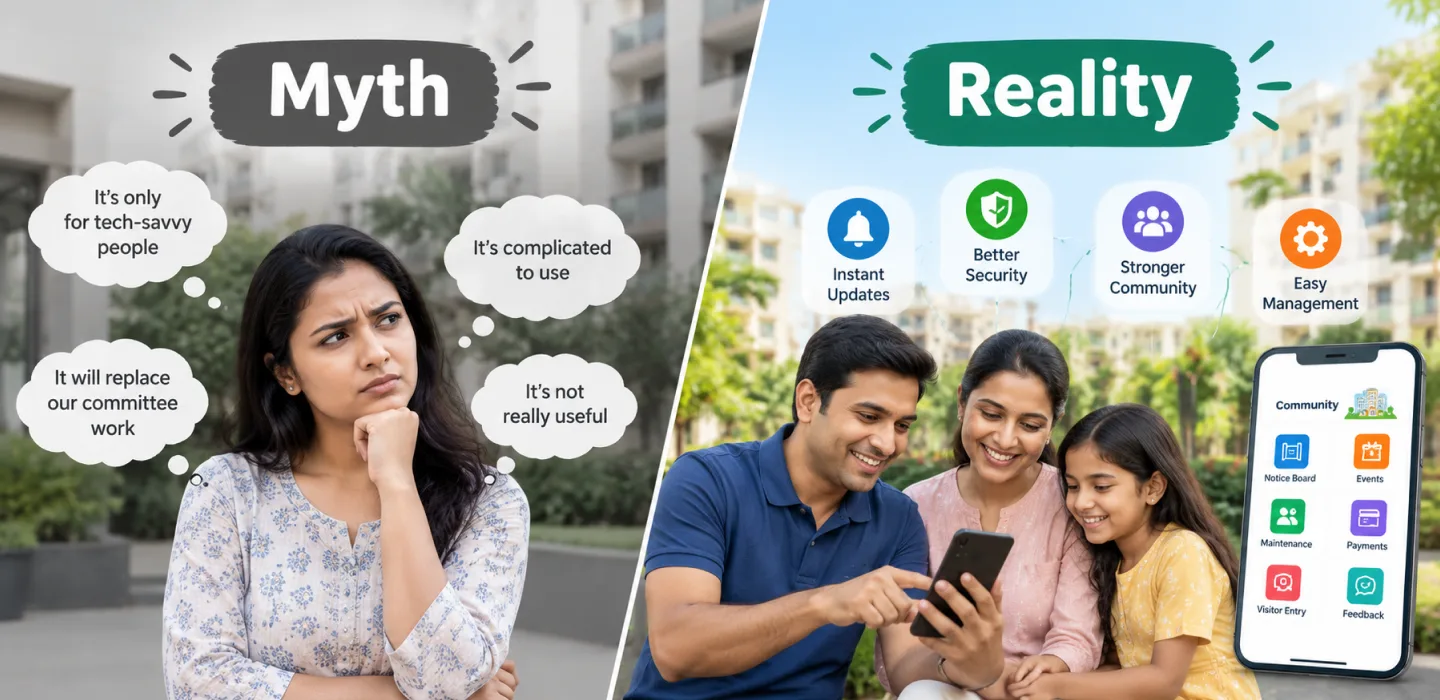
Another common misconception about community apps is that they are overly complex and challenging to use. In reality, platforms like MyKutir are designed with user-friendliness in mind, featuring intuitive interfaces that require minimal technical knowledge to navigate. MyKutir also provides comprehensive support and training resources to help residents and management teams become comfortable with the app's functionalities.

Cost is another factor that often deters communities from adopting these apps. There's a belief that implementing a community app is an expensive endeavor that will strain the society's budget. However, the truth is that while there may be initial setup costs, the long-term efficiency and savings gained from streamlined operations, reduced administrative workload, and improved financial management often justify the investment.

Additionally, some societies are under the impression that community apps are only suitable for large residential complexes. This myth overlooks the flexibility and scalability of platforms like MyKutir, which can be customized to meet the needs of both small and large societies alike. Features can be tailored, allowing societies of all sizes to take advantage of digital management solutions.

By dispelling these myths, housing societies can more accurately weigh the benefits of implementing a community app. Understanding the true capabilities and benefits of platforms like MyKutir can help communities overcome hesitation and move towards more efficient and effective management solutions.

The Reality: Benefits of Community Apps

The actual benefits of community apps in residential societies go beyond mere convenience; they offer significant improvements in communication, management, and transparency. One of the standout features of MyKutir is the enhancement of community communication. Through digital notices and announcements, residents can receive timely updates about society events, maintenance activities, and other essential information without the lag associated with traditional notice boards or WhatsApp groups.

Efficient management of amenities and complaints is another significant benefit. MyKutir's complaint management system allows residents to log issues directly through the app, ensuring that they are promptly addressed by the relevant authorities. This feature helps in maintaining the upkeep of facilities and can lead to quicker resolutions, enhancing resident satisfaction.

Financial transparency is another area where community apps like MyKutir excel. The platform offers comprehensive billing features that make it easy for societies to manage and track dues, payments, and financial records. The app generates detailed reports that provide a clear view of financial transactions, helping committees make informed decisions and fostering trust among residents through transparent financial management.

Moreover, MyKutir facilitates improved visitor management, a crucial aspect of ensuring security in residential societies. The app's visitor management system allows residents to pre-register guests, authorizing their entry and ensuring that security personnel have accurate visitor records. This feature not only enhances security but also reduces manual entry errors and wait times.

Ultimately, community apps like MyKutir help transform residential management into a more organized, efficient, and resident-centric process. By leveraging these digital tools, societies can enhance their operations, reduce administrative workloads, and create a more connected and engaged community environment.

Case Study: A Residential Community's Transformation

Consider the hypothetical scenario of Surya Enclave, a mid-sized residential community grappling with common management challenges. Before adopting a community app, the society relied heavily on manual processes, such as physical notice boards for communication, paper-based billing, and manual visitor logs. These traditional methods often led to delays, miscommunications, and inefficiencies.

Upon implementing MyKutir, Surya Enclave experienced a notable transformation. The digital notice feature allowed for instantaneous dissemination of announcements, ensuring all residents were informed of important updates simultaneously. This reduced the instances of residents missing out on essential information and fostered a more connected community environment.

The billing process underwent a significant overhaul. Previously, the manual generation and distribution of bills were time-consuming and prone to errors. With MyKutir’s billing feature, the process became automated, reducing errors and administrative workload. Residents appreciated the transparency and ease of accessing their payment history and dues online.

Visitor management also improved substantially. Before MyKutir, security personnel maintained visitor logs manually, which was both inefficient and insecure. Through the app, the pre-registration of guests became seamless, enhancing both security and convenience for residents and visitors alike.

Furthermore, the app's AI-assisted features provided the management committee with valuable insights into community trends and operational efficiencies. They could track complaint resolutions, analyze financial data, and plan better for future investments and improvements based on accurate, real-time data.

Surya Enclave's transformation illustrates the potential of community apps like MyKutir to improve residential society management significantly. By moving from outdated manual processes to a modern digital platform, the society was able to enhance communication, streamline operations, and create a more pleasant living environment for its residents.

MyKutir's Approach to Community Management

MyKutir takes a comprehensive approach to community management, addressing multiple facets of residential living through its versatile platform. At the core of MyKutir's offerings is a commitment to enhancing communication and operational efficiency within housing societies.

One of MyKutir's standout features is its digital notice system, which allows society committees to send announcements directly to residents' devices. This feature ensures that residents receive important updates promptly, reducing the delays inherent in traditional communication methods. Whether informing about maintenance schedules or announcing community events, digital notices keep everyone in the loop.

In addition to enhancing communication, MyKutir offers robust financial management tools. Societies can utilize the platform for billing residents, tracking payments, and generating financial reports, thereby promoting transparency and accountability. These tools allow management committees to efficiently handle financial operations without the risk of errors and omissions common in manual methods.

Visitor management is another critical area where MyKutir excels. The app's visitor management feature streamlines the process of guest entry, permitting residents to pre-authorize visitors. This capability not only enhances security by providing security personnel with accurate records but also streamlines the entry process, reducing wait times and improving resident satisfaction.

Furthermore, MyKutir integrates AI assistance to provide intelligent insights into community management. This innovative feature aids committees in making informed decisions by highlighting trends, potential issues, and areas for improvement. From analyzing complaint data to predicting maintenance needs, AI provides a data-driven approach to community management.

Overall, MyKutir's approach to community management is one of integration and efficiency. By addressing the multifaceted needs of residential societies, MyKutir provides a comprehensive solution that facilitates better management practices, enhances resident satisfaction, and ensures smooth community operations.

Comparison: Traditional Methods vs. Community Apps

Aspect Traditional Methods Community Apps (e.g., MyKutir)
Communication Physical notice boards, WhatsApp groups Digital notices, in-app announcements
Billing Manual paper-based billing Automated billing, online payment tracking
Visitor Management Manual logbooks Pre-registration, digital logs
Complaint Management Physical registers In-app complaint submission and tracking
Financial Reporting Excel sheets, manual calculations Automated reports, real-time data access
Data Security Vulnerable to loss and unauthorized access Secure data handling with encryption

As illustrated in the comparison table above, community apps like MyKutir offer significant advantages over traditional management methods. While physical notice boards and WhatsApp groups are often used for communication, they can be inefficient and prone to delays or miscommunications. In contrast, digital notices and in-app announcements provide direct, timely communication, ensuring all residents are informed simultaneously.

Billing and financial management also see considerable improvements with community apps. Manual paper-based billing is not only cumbersome but also prone to errors and delays. MyKutir offers automated billing and online payment tracking, which streamlines the process, reduces errors, and enhances transparency.

Visitor management is another critical area where community apps have an edge. Traditional manual logbooks are susceptible to inaccuracies and security risks. MyKutir's visitor management feature allows for pre-registration and maintains digital logs, enhancing both security and efficiency.

Overall, the transition from traditional methods to digital platforms like MyKutir represents a significant leap in efficiency, accuracy, and transparency. These benefits lead to improved community management and higher resident satisfaction.

Overcoming Common Implementation Challenges

The implementation of community apps often faces several challenges, but with careful planning and consideration, societies can overcome these hurdles effectively. One of the common challenges is resistance to change. Residents and management committees accustomed to traditional methods may be hesitant to adopt new technology. To address this, it is crucial to communicate the benefits of the app clearly and involve residents in the decision-making process, making them feel part of the transition.

Another challenge is the perceived complexity of community apps. Some residents may feel intimidated by new technology, fearing that they won't be able to use it effectively. MyKutir addresses this concern by providing comprehensive training and support resources. Workshops, tutorials, and step-by-step guides can help users become comfortable with the app, ensuring they can utilize its full potential.

Data security concerns also pose a significant challenge. Residents need reassurance that their personal information will be safeguarded. MyKutir employs robust encryption and security protocols to protect resident data, but transparent communication about these measures is essential to alleviate any fears.

Cost is another factor that can hinder implementation. Societies may worry about the financial implications of adopting a digital platform. However, it's important to consider the long-term savings in administrative costs and the efficiency gains that a community app can provide. MyKutir offers scalable solutions to fit different budgetary requirements, ensuring societies can find a package that suits their financial needs.

Finally, technical challenges, such as integration with existing infrastructure, can arise. MyKutir is designed to integrate seamlessly with existing systems, minimizing disruption. Technical support teams can assist in resolving any issues that arise during integration, ensuring a smooth transition.

By addressing these common challenges proactively, societies can successfully implement a community app like MyKutir and enjoy the myriad benefits it offers.

Step-by-Step: Implementing a Community App Successfully

  1. Planning: Begin by assessing the needs of your residential community. Understand the areas where a community app can add the most value, such as communication, billing, or visitor management. Involve key stakeholders in this initial assessment to gather diverse insights.
  2. Selection: Research available community apps and select one that best meets your society's needs. Consider factors such as user-friendliness, feature set, data security, and cost. Platforms like MyKutir offer a range of features designed for Indian housing societies, making them a suitable choice for many communities.
  3. Training and Onboarding: Once a platform is selected, plan a training program for residents and management staff. Utilize MyKutir's resources, such as tutorials and workshops, to help users become familiar with the app’s features and functionality.
  4. Implementation: Implement the app in phases, starting with the most critical features. This phased approach allows users to acclimate gradually, reducing overwhelm and resistance. Collaborate with MyKutir's support team to ensure a smooth setup and address any technical issues promptly.
  5. Feedback and Adjustment: After initial implementation, gather feedback from users to identify any issues or areas for improvement. Use this feedback to make necessary adjustments and enhancements, ensuring the app effectively meets the community's needs.
  6. Evaluation: Periodically evaluate the app’s impact on community management. Analyze usage data, resident satisfaction, and operational efficiencies to determine the app’s effectiveness and return on investment. Make ongoing adjustments to optimize its use.

By following these steps, residential communities can successfully implement a community app like MyKutir, ensuring a smooth transition from traditional management methods to a modern, efficient digital platform.

FAQs About Community Apps in Residential Communities

What are community apps?

Community apps are digital platforms designed to facilitate the management and communication needs of residential societies. They offer a range of features, such as billing, visitor management, and digital notices, aimed at streamlining daily operations and improving resident engagement. By centralizing multiple management functions, community apps help societies operate more efficiently and create a more connected living environment.

Are community apps secure for handling resident data?

Yes, community apps like MyKutir prioritize data security, implementing advanced encryption and security protocols to protect resident information. These platforms typically adhere to industry best practices and compliance requirements to ensure personal data is safeguarded against unauthorized access and breaches. However, it's important for societies to regularly update their security settings and stay informed about any new security features or updates provided by the app.

How can community apps improve communication in housing societies?

Community apps enhance communication by providing a centralized platform for sending announcements, updates, and notices directly to residents. With features like digital notices and in-app messaging, societies can ensure timely and accurate dissemination of information, reducing reliance on slower traditional methods such as physical notice boards or fragmented WhatsApp groups. This leads to improved resident awareness and engagement with community activities and decisions.

What are the costs associated with implementing a community app?

The costs of implementing a community app can vary depending on the platform chosen and the specific needs of the society. Generally, there may be initial setup fees, subscription costs, and potential expenses for training and support. However, the efficiency gains and savings in administrative costs often offset these initial expenses. MyKutir offers flexible pricing plans that can be tailored to fit different budgetary constraints, making it accessible to a wide range of residential communities.

How does MyKutir support housing societies in adopting community apps?

MyKutir provides extensive support to housing societies adopting their community app. From initial setup to ongoing assistance, MyKutir offers training resources, tutorials, and customer support to ensure users can effectively utilize the app’s features. Additionally, MyKutir’s team works closely with societies to address any technical issues or customization needs, facilitating a smooth transition to digital management.

Can community apps be customized for specific society needs?

Yes, community apps like MyKutir can often be customized to cater to the specific needs of different residential societies. Customization options may include tailored features, user interfaces, and integrations with existing systems. Working with the app provider, societies can identify their unique requirements and collaborate on developing a customized solution that enhances their management capabilities while meeting residents' specific needs.

What are the challenges in implementing community apps?

Implementing community apps can present challenges such as resistance to change, perceived complexity, and data security concerns. Societies may face reluctance from residents who are accustomed to traditional methods, or from those intimidated by new technology. However, addressing these challenges through clear communication of benefits, comprehensive training, and assurances of data security can facilitate successful adoption. Additionally, MyKutir's support and scalable solutions help address cost concerns and technical challenges, ensuring a smoother implementation process.

Key Takeaways

← Back to Blog