Effective Parking Management in Housing Societies: A Comparison Guide
By MyKutir Editorial Team — 2026-09-25
Discover strategies for effective parking management in housing societies, comparing digital solutions to traditional methods.
Effective parking management is essential for ensuring smooth operations, safety, and resident satisfaction in Indian housing societies. With urban populations increasing and housing complexes becoming denser, the need for efficient parking solutions has never been greater. Common challenges faced by societies include limited parking spaces, unauthorized parking, and disputes among residents over parking rights. Traditional methods of parking management often fall short in addressing these issues, leading to frustration and conflicts. To combat these challenges, housing societies are increasingly turning to digital solutions that offer more efficient and adaptable options for parking management.
Traditional management approaches typically rely on manual systems, such as registers and fixed numbered slots, which can be cumbersome to maintain and monitor. These methods, while straightforward, lack the flexibility and real-time capabilities needed to address the growing demands of modern housing societies. In contrast, digital solutions provide advanced features such as real-time tracking of parking spaces, automated visitor management, and seamless integration with mobile applications. These systems are designed to offer a more comprehensive approach to managing parking, ensuring better compliance with rules and enhancing overall resident satisfaction.
Traditional Parking Management Approaches
Traditional parking management in housing societies primarily involves manual processes, such as maintaining physical registers for tracking parking space allocations and utilizing fixed numbered slots for vehicles. This approach has been the norm for many years, primarily due to its simplicity and low implementation cost. Housing societies often designate parking slots based on apartment numbers or through a lottery system, and residents are expected to adhere to these allocations.
The advantages of traditional methods lie in their straightforward nature. There is no need for advanced technology or digital infrastructure, making it accessible for societies with limited resources. Moreover, the familiar nature of these systems means that residents and staff can easily understand and adhere to the parking rules without requiring extensive training.
However, these methods also come with significant disadvantages. The lack of real-time monitoring and enforcement can lead to unauthorized parking, disputes over allocated spaces, and inefficient use of available parking areas. Manual registers are prone to errors and can be time-consuming to update, leading to inaccurate records. Additionally, these systems offer little flexibility in adapting to changes such as increased vehicle ownership or the need for visitor parking. As a result, traditional methods can often lead to dissatisfaction among residents and increased administrative burdens for society management.
Digital Parking Management Solutions
Digital parking management solutions are revolutionizing how housing societies manage their parking spaces. These modern systems offer a range of features designed to streamline operations and enhance resident satisfaction. A key advantage of digital solutions is their ability to provide real-time tracking of parking spaces. This feature allows societies to monitor the availability of parking slots in real time, reducing the likelihood of unauthorized parking and ensuring that residents can easily find a spot.
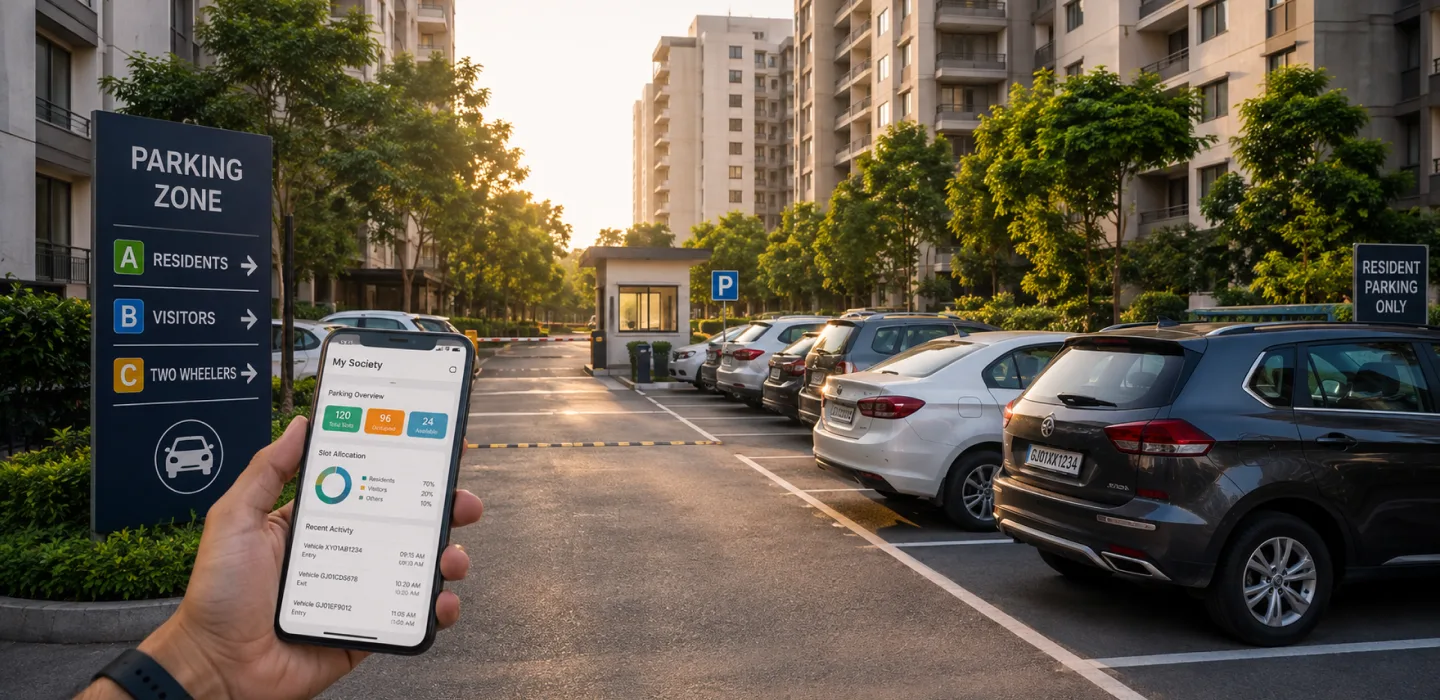
One of the standout capabilities of MyKutir's platform is its integration with mobile apps, enabling residents to manage their parking needs directly from their smartphones. Through the app, residents can view available parking spots, book spaces, and even generate automated visitor passes. This level of convenience greatly enhances user experience and ensures that parking management is efficient and hassle-free.
Digital systems also offer automated alerts and notifications for both residents and management, keeping everyone informed about parking-related updates and any policy changes. This facilitates better compliance and reduces the scope for disputes. Another key feature is the ability to generate detailed reports and analytics, providing valuable insights into parking utilization and helping societies make data-driven decisions to optimize their parking spaces.
Overall, digital parking management solutions offer a more dynamic, flexible, and efficient approach compared to traditional methods. They not only address existing challenges but also prepare societies to meet future demands, making them an ideal choice for modern housing complexes.
Comparison of Digital vs. Traditional Approaches
| Aspect | Traditional Methods | Digital Solutions |
|---|---|---|
| Cost | Low initial cost but high ongoing administrative expenses | Higher initial investment but lower long-term operational costs |
| Efficiency | Time-consuming, prone to errors, and lacks real-time monitoring | Automated, accurate, and offers real-time updates |
| Ease of Use | Simple to understand but cumbersome to manage | User-friendly interfaces and mobile app integration |
| Adaptability | Rigid and difficult to update | Highly adaptable, scalable, and easy to modify |
When comparing traditional and digital parking management approaches, several significant differences emerge. Traditional methods may appeal due to their low initial cost and simplicity, but they often lead to higher ongoing administrative expenses. Digital solutions, on the other hand, require a higher upfront investment, but the long-term operational costs are generally lower due to automation and efficiency gains.
Efficiency is another critical factor. Manual systems are time-consuming and prone to errors, and they lack the capability for real-time monitoring. Digital solutions automate processes, provide real-time updates, and enhance accuracy, leading to better parking space utilization. In terms of ease of use, traditional systems, while simple, can become cumbersome to manage, especially in larger societies. Digital platforms offer user-friendly interfaces and integration with mobile applications, making them more convenient for residents and management alike.
Finally, adaptability to future needs is a crucial consideration. Traditional systems are often rigid and difficult to update, whereas digital solutions are highly adaptable and scalable. This flexibility ensures that societies can respond to changing demands and technological advancements effectively.
Case Study: Successful Implementation of Digital Parking Management
Consider a hypothetical housing society, "Green Meadows," facing severe parking challenges. Limited parking spaces, frequent unauthorized parking, and resident disputes over slots were commonplace. The society's management decided to transition from a traditional manual system to a digital parking management solution offered by MyKutir.
The implementation began with a detailed assessment of the society's parking needs, followed by the installation of IoT-enabled sensors in parking slots to provide real-time tracking. The society adopted MyKutir's mobile app, enabling residents to view available parking spaces, reserve slots, and generate visitor passes conveniently from their smartphones. Automated notifications kept residents informed of parking policy changes and slot availability.
Within months, Green Meadows witnessed significant improvements. Unauthorized parking incidents reduced by 80%, and the society reported a 90% increase in resident satisfaction with parking arrangements. The digital system also facilitated better space utilization, with data analytics revealing peak usage times and allowing management to optimize slot allocations accordingly.
The transition also enhanced transparency, as residents could access parking reports and monitor compliance with rules. The society's management found administrative tasks less burdensome, freeing up time for other essential functions. Ultimately, the successful implementation of a digital parking management solution transformed Green Meadows, demonstrating the tangible benefits of embracing technology.
Common Mistakes in Parking Management and How to Avoid Them
Effective parking management in housing societies requires careful planning and execution. However, common mistakes can lead to dissatisfaction and operational inefficiencies. One prevalent error is poor communication of parking policies. If residents are not clearly informed about the rules, such as slot allocations, visitor parking provisions, and penalties for violations, confusion and disputes are likely to arise. To avoid this, society management should ensure that parking policies are well-documented, regularly communicated, and easily accessible to all residents.
Another mistake is inconsistent enforcement of parking rules. If penalties for unauthorized parking or policy breaches are not uniformly applied, residents may perceive a lack of fairness and accountability. It's crucial for societies to establish clear enforcement procedures and ensure that they are consistently followed. Leveraging technology, such as automated alerts for violations, can aid in maintaining consistent rule enforcement.
Inadequate planning for future needs also poses challenges. As vehicle ownership increases and societies expand, the demand for parking spaces may outstrip supply. Societies should anticipate these changes and explore scalable solutions, such as digital parking management systems, that can adapt to evolving demands.
To mitigate these challenges, societies can benefit from conducting regular assessments of parking needs and engaging with residents to gather feedback. This proactive approach can help identify potential issues early and implement technology-driven solutions that enhance efficiency and satisfaction.
Step-by-Step Guide to Implementing a Digital Parking Management System
Transitioning from a traditional to a digital parking management system requires careful planning and execution. Here is a step-by-step guide to help housing societies make this transition smoothly:
- Assess Parking Needs: Begin by evaluating the current parking situation in your society. Identify existing challenges, such as unauthorized parking or space shortages, and gather feedback from residents to understand their concerns.
- Research and Select a Solution: Explore different digital parking management solutions available in the market. Consider factors such as features, ease of use, scalability, and cost. MyKutir’s platform offers comprehensive capabilities tailored to housing societies.
- Plan the Implementation: Develop a detailed implementation plan, including timelines, responsibilities, and budget considerations. Ensure that the plan addresses both technical aspects, such as hardware installation, and user-related components, like training sessions.
- Install Necessary Infrastructure: Set up the required digital infrastructure, such as sensors and IoT devices, for real-time tracking. Ensure that the system is seamlessly integrated with residents' mobile applications.
- Conduct Training and Communication: Organize training sessions for residents and management staff to familiarize them with the new system. Communicate the benefits and functionalities of the digital solution to encourage adoption.
- Monitor and Adjust: After implementation, closely monitor the system's performance and gather resident feedback. Use this information to make necessary adjustments and improve the system's efficiency over time.
By following these steps, societies can effectively transition to a digital parking management system, enhancing efficiency and resident satisfaction.
Legal Considerations in Parking Management for Housing Societies
Parking management in housing societies involves various legal and compliance considerations. Different states in India have specific regulations governing housing societies, and it's essential for societies to comply with these rules. For instance, the Societies Registration Act 1860, Cooperative Societies Acts, or Apartment Ownership Acts may have implications for parking management policies. However, thresholds and rules can vary significantly by state and change over time, so it's crucial to confirm specifics with a Chartered Accountant or society registrar.
Additionally, societies must consider the principles of mutuality in income tax, which may impact the treatment of parking fees collected from residents. Understanding the tax implications and ensuring compliance with TDS requirements is essential to avoid potential legal issues.
Disputes related to parking allocations or unauthorized parking may also require resolution through legal channels. Societies should have clear documentation of parking policies, enforcement procedures, and penalties to mitigate the risk of disputes escalating into legal battles.
Given the complexity of these legal considerations, engaging with legal experts and consultants who specialize in housing society laws can provide valuable guidance. By ensuring legal compliance, societies can avoid potential pitfalls and manage their parking arrangements effectively.
Future Trends in Parking Management for Housing Societies
As technology continues to evolve, several future trends in parking management are emerging. One such trend is the integration of Artificial Intelligence (AI) in parking systems. AI-driven space allocation can optimize parking slot assignments based on real-time data, ensuring efficient utilization and reducing congestion. Automated enforcement mechanisms, powered by AI, can also enhance rule compliance by detecting violations and issuing penalties without manual intervention.
Another trend is the rise of shared mobility solutions, such as carpooling and car-sharing services. Housing societies may need to adapt their parking management systems to accommodate these new forms of transportation. Digital solutions that offer flexible parking arrangements and support for electric vehicle charging stations will become increasingly relevant.
In preparing for these advancements, housing societies should consider adopting digital systems with built-in flexibility and scalability. This ensures that societies can easily integrate new technologies and adapt to changing demands.
Moreover, as environmental sustainability gains importance, societies may explore green parking solutions that prioritize eco-friendly practices. Encouraging the use of bicycles, implementing smart lighting systems, and promoting electric vehicle adoption can contribute to a more sustainable approach to parking management.
By staying informed about future trends and embracing digital solutions, housing societies can position themselves to meet evolving needs and enhance overall efficiency and resident satisfaction in their parking management efforts.
FAQs
What are the benefits of digital parking management in housing societies?
Digital parking management systems offer numerous benefits, including real-time tracking of parking spaces, which reduces unauthorized parking incidents and ensures efficient space utilization. These systems also provide automated visitor management and seamless integration with mobile apps, enhancing convenience for residents. By automating processes and reducing manual oversight, digital solutions lower long-term operational costs and improve overall efficiency. Additionally, they offer valuable insights through data analytics, helping societies make informed decisions and optimize parking arrangements over time.
How do traditional parking management methods compare to digital solutions?
Traditional parking management methods rely on manual processes, such as physical registers and fixed numbered slots, which can be simple yet cumbersome to manage. These methods often lack real-time monitoring and adaptability, leading to inefficiencies and potential disputes. In contrast, digital solutions offer automated, accurate, and real-time tracking capabilities, improving efficiency and user experience. While digital systems require a higher initial investment, they tend to have lower long-term operational costs due to increased automation and reduced administrative burdens.
What are common mistakes in parking management?
Common mistakes in parking management include poor communication of policies, inconsistent enforcement of rules, and inadequate planning for future needs. These errors can lead to confusion, disputes, and resident dissatisfaction. Societies can avoid these pitfalls by ensuring clear documentation and regular communication of parking policies, establishing consistent enforcement procedures, and proactively assessing and addressing changing parking demands. Leveraging technology can also aid in maintaining transparency and efficiency in parking management.
How can a housing society implement a digital parking management system?
Implementing a digital parking management system involves several steps, beginning with assessing the society's current parking needs and identifying existing challenges. Next, societies should research and select a suitable digital solution, considering factors such as features, scalability, and cost. Once a solution is chosen, a detailed implementation plan should be developed, covering technical infrastructure installation, user training, and communication efforts to encourage adoption. Continuous monitoring and adjustments based on resident feedback are essential to ensure the system's effectiveness.
What legal aspects should be considered in parking management for housing societies?
Legal considerations in parking management include compliance with state-specific regulations such as the Societies Registration Act, Cooperative Societies Acts, and Apartment Ownership Acts, which may impact parking policies. Societies should also be aware of the income-tax mutuality principle and TDS requirements related to parking fees. To avoid potential legal issues, societies should consult legal experts and ensure that their parking policies and enforcement procedures are well-documented and compliant with applicable laws.
What future trends should housing societies anticipate in parking management?
Future trends in parking management include the integration of AI-driven space allocation and automated enforcement mechanisms, which enhance efficiency and compliance. The rise of shared mobility solutions and the increasing adoption of electric vehicles will also shape parking management practices. Housing societies should consider adopting flexible digital systems that can accommodate these advancements and support environmentally sustainable practices, such as promoting bicycles and implementing smart lighting systems. By staying informed about these trends, societies can position themselves to meet evolving needs and enhance resident satisfaction.
Key Takeaways
- Effective parking management is crucial for resident satisfaction and operational efficiency in housing societies.
- Traditional methods, while simple, often lack real-time capabilities and adaptability, leading to inefficiencies.
- Digital solutions provide real-time tracking, mobile app integration, and data analytics, enhancing overall parking management.
- Implementing a digital system requires careful planning, including assessing needs and training users.
- Legal compliance is key, and societies should consult experts to navigate regulations effectively.
- Future trends include AI integration and support for eco-friendly practices like electric vehicle adoption.