Unveiling the Impact of AI-Assisted Notice Creation in Residential Communities
By MyKutir Editorial Team — 2026-09-25
Discover how AI-assisted notice creation transforms communication in residential communities, enhancing efficiency and engagement.
In recent years, the role of artificial intelligence (AI) in managing residential communities has expanded rapidly. One significant area where AI is making a profound impact is in the creation and distribution of notices. Traditionally, notice creation has been a manual, labor-intensive process fraught with challenges of inefficiency and inconsistency. The integration of AI into this domain promises to revamp the process, making it more efficient and effective. This article delves into the impact of AI-assisted notice creation in residential communities, exploring its benefits, challenges, and future trends.
Introduction to AI-Assisted Notice Creation
The traditional notice creation process in residential communities often involves manual drafting, reviewing, and distribution. This process can be time-consuming, with room for errors and inconsistencies, especially in larger societies where numerous notices need to be sent regularly. The reliance on manual methods often leads to delays, miscommunication, and a general inefficiency that can hinder effective community management.
AI-assisted notice creation emerges as a solution to these challenges by streamlining the process through automation and intelligent algorithms. By leveraging AI, residential communities can ensure timely, accurate, and consistent communication with their residents. This shift from manual to automated notice creation not only saves time but also improves the quality and efficacy of communications.
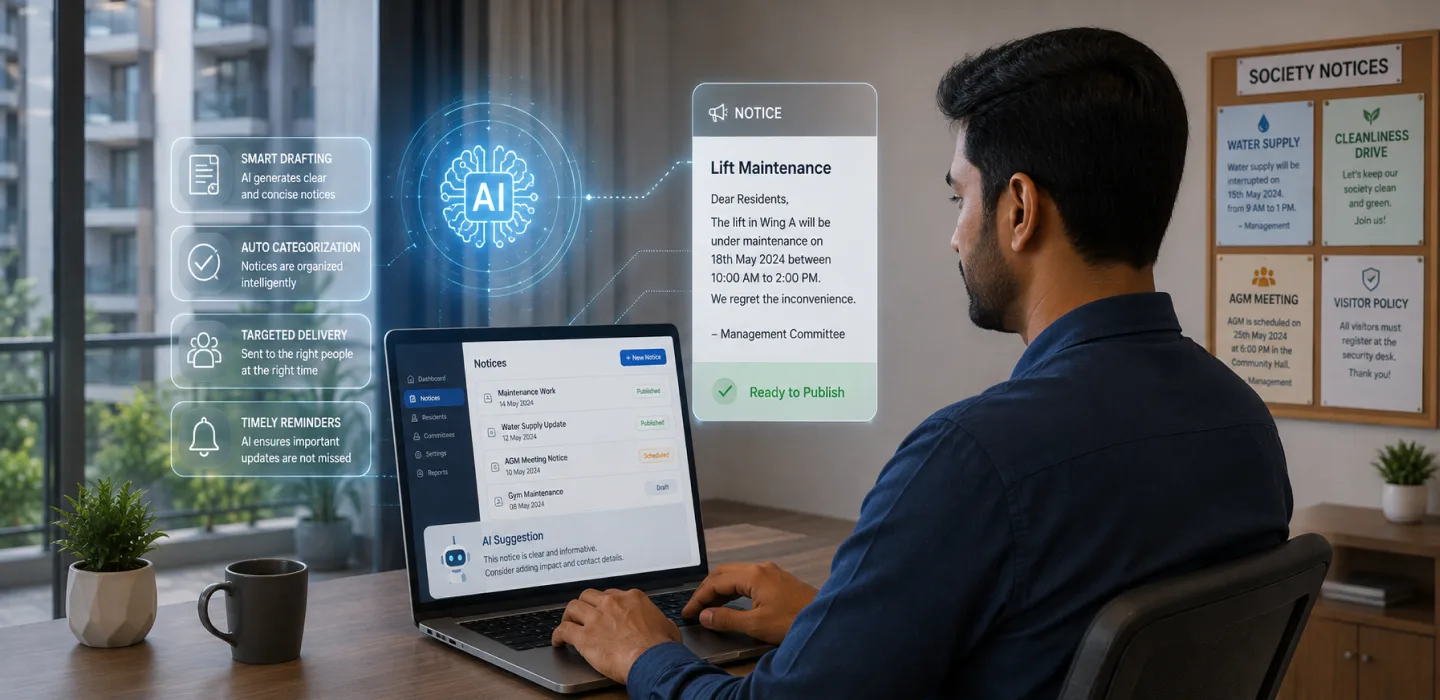
AI tools can automate the drafting of notices by generating templates based on historical data and natural language processing. They can also assist in the personalization of notices, ensuring that the communication is relevant and engaging for residents. Furthermore, AI can analyze past notice performance to optimize future notices for better engagement.
By integrating AI into notice creation, residential communities can alleviate many of the traditional challenges they face, leading to enhanced communication and resident satisfaction. The transformation is not just technological but also organizational, as it requires a change in mindset from manual to automated processes.
How AI Tools Enhance Notice Creation
MyKutir offers a suite of AI tools specifically designed to enhance notice creation within residential communities. These tools, including the notice authoring assist and RAG search over notices, are designed to simplify and improve the notice creation process.
The notice authoring assist tool utilizes AI algorithms to aid in the drafting of notices. It suggests relevant content and phrases based on the context and purpose of the notice, reducing the time and effort required to create high-quality communications. The tool's technical foundation lies in natural language processing (NLP), which enables it to understand and generate human-like text efficiently.
On the other hand, the RAG search over notices tool allows community managers to quickly search through past notices using a color-coded system to identify the relevance of notices to current situations. RAG, which stands for Red-Amber-Green, categorizes notices based on their urgency and importance, helping managers prioritize their communications more effectively.
These AI tools offer numerous benefits over manual processes. Firstly, they significantly reduce the time required to draft and distribute notices. Secondly, they enhance accuracy by minimizing human errors that can occur during manual drafting. Thirdly, they improve engagement by generating content that is both relevant and compelling for residents.
By adopting these AI tools, residential communities can transition from cumbersome manual processes to a more streamlined and effective approach to notice creation. This not only improves operational efficiency but also enhances overall resident satisfaction through better communication.
The Impact on Community Communication
AI-assisted notice creation fundamentally transforms how communication occurs within residential communities. The use of AI streamlines the process, ensuring that notices are not only timely but also clear and engaging, fostering better communication and understanding among residents.
One of the primary impacts of AI-assisted notice creation is the improvement in clarity. AI tools ensure that notices are free from grammatical errors and inconsistencies, providing residents with clear and concise information. This clarity is crucial in preventing misunderstandings and ensuring that residents are well-informed about community events and updates.
Timeliness is another significant benefit. With AI automation, notices can be generated and distributed much faster than through manual methods. This ensures that residents receive important information promptly, allowing them to respond or act accordingly. For instance, in emergencies, AI can automatically prioritize and send out notices efficiently, keeping everyone informed and safe.
Moreover, AI-assisted notice creation enhances engagement among residents. By tailoring notices to the interests and preferences of different resident groups, AI tools ensure that the content is relevant and engaging. This personalization can increase read rates and encourage active participation in community events and initiatives.
Beyond these immediate benefits, AI-assisted notice creation can foster a sense of community by ensuring that everyone is on the same page. When communication is effective, residents are more likely to feel connected to their community, leading to increased satisfaction and a stronger sense of belonging.
Scenario: Implementing AI-Assisted Notices in a Society
Imagine a residential community called Green Meadows, which has decided to transition from manual to AI-assisted notice creation to improve communication efficiency. The process begins with the community management team attending a demonstration of MyKutir's AI tools, gaining insights into how these tools can benefit their notice creation process.
The first stage involves setup and integration. The management team works with MyKutir experts to integrate the AI tools into their existing systems. During this phase, data from past notices is uploaded to the system, allowing the AI to analyze historical patterns and preferences.
Next comes training. Community managers and staff undergo training sessions to familiarize themselves with the AI tools. These sessions cover aspects such as drafting notices using the authoring assist tool and utilizing the RAG search feature to manage notice priorities.
As AI tools are gradually implemented, initial challenges arise. One major hurdle is resistance from staff accustomed to traditional methods. To address this, the management team holds workshops to demonstrate the benefits of AI, emphasizing how it can make their work easier and more efficient.
Over time, the benefits become evident. Notices are created and distributed faster, reducing delays in communication. The AI-generated content is consistently accurate and engaging, leading to positive feedback from residents who appreciate the clarity and relevance of the notices.
Ultimately, the community observes improved communication and higher resident satisfaction. The transition to AI-assisted notice creation not only enhances operational efficiency but also fosters a more connected and engaged community.
Common Mistakes in Adopting AI Tools
Adopting AI tools for notice creation in residential communities can bring about significant improvements, but it also comes with potential pitfalls. Understanding these common mistakes can help societies successfully integrate AI into their processes.
One common mistake is over-reliance on AI tools without human oversight. While AI can automate many tasks, human review is still essential to ensure that notices are contextually appropriate and align with community values. AI may suggest content based on algorithms, but community managers need to apply judgment to finalize notices.
Another mistake is inadequate training. Without proper training sessions, staff may struggle to use the AI tools effectively, leading to frustration and underutilization. To avoid this, comprehensive training should be conducted, ensuring that all users are comfortable and confident in using the new system.
Failing to customize AI tools according to the community's specific needs is another common pitfall. AI tools offer various customization options, and not utilizing these can result in generic notices that do not resonate with residents. Communities should explore customization features to tailor notices to their unique requirements.
Moreover, some communities might overlook data privacy concerns. AI tools process resident data to personalize notices, and it's crucial to follow best practices in data management and storage to avoid potential breaches. Clear communication with residents about how their data is used and protected can help mitigate concerns.
By being aware of these common mistakes and implementing strategies to address them, residential communities can maximize the benefits of AI-assisted notice creation while minimizing potential risks.
Digital vs. Manual: A Comparison Table
| Aspect | Manual Process | AI-Assisted Process |
|---|---|---|
| Efficiency | Time-consuming; requires multiple drafts | Automated, reduces time required |
| Accuracy | Prone to human errors | Minimizes errors through AI validation |
| Time | Delays common due to manual input | Quicker distribution, instantaneous updates |
| Resident Satisfaction | Varies; often inconsistent communication | Higher satisfaction due to clarity and relevance |
Step-by-Step Guide to Transitioning to AI-Assisted Notices
Transitioning from manual to AI-assisted notice creation can seem daunting, but with a systematic approach, residential communities can navigate the process smoothly. Here is a step-by-step guide to help societies make the shift effectively.
Step 1: Assess Current Processes - Begin by evaluating your current notice creation process. Identify pain points such as time delays, inaccuracies, or engagement issues that AI tools can address. Understanding where improvements are needed will guide the integration process.
Step 2: Choose the Right AI Tools - Research available AI tools like those offered by MyKutir. Evaluate their features and compatibility with your existing systems. Consider tools with notice authoring assist and RAG search capabilities for comprehensive optimization.
Step 3: Develop a Transition Plan - Create a detailed plan outlining the steps for integration, including timelines, responsibilities, and resources required. Ensure that all stakeholders are informed and involved in the planning process.
Step 4: Conduct Training Sessions - Organize training sessions for community managers and staff to learn how to use the new AI tools. Provide hands-on training to build confidence and address any concerns or questions users may have.
Step 5: Start with a Pilot Project - Implement the AI tools in a small segment of your community as a pilot project. This allows you to test the tools, gather feedback, and make necessary adjustments before a full-scale rollout.
Step 6: Gather Feedback and Iterate - After the pilot, collect feedback from users and residents to evaluate the effectiveness of the AI tools. Use this feedback to refine the process and address any issues that arise.
Step 7: Full Implementation - Once adjustments have been made based on feedback, proceed with a full implementation across the community. Continue to monitor the system's performance and make improvements as needed.
By following these steps, residential communities can successfully transition to AI-assisted notice creation, resulting in improved efficiency and resident satisfaction.
Future Trends in AI and Community Management
As AI technology continues to evolve, its role in community management is expected to expand beyond notice creation. Several future trends could shape the way residential communities operate, offering new functionalities and efficiencies.
One potential development is the integration of AI with Internet of Things (IoT) devices within communities. AI could analyze data from smart home devices, providing insights into energy usage, security, and overall community infrastructure. This integration could enhance resource management and improve the quality of life for residents.
Another trend is the use of AI for predictive analytics in community management. AI tools could forecast community needs, such as maintenance schedules, based on historical data and trends. This proactive approach could lead to cost savings and prevent issues before they arise.
AI-driven chatbots or virtual assistants could also become more prevalent, providing residents with instant access to community information, FAQs, and support. This technology can improve resident interaction and reduce the workload on community management staff.
Moreover, AI could play a role in enhancing community engagement through personalized communication. By analyzing resident preferences and behavior, AI could tailor communication strategies, ensuring that notices, events, and updates align with resident interests.
While these developments hold promise, it's essential for communities to balance technological advancements with ethical considerations, such as privacy and data security. As AI becomes more integrated into community management, maintaining transparency and trust with residents will be crucial.
Frequently Asked Questions
How does AI assist in notice creation?
AI assists in notice creation by automating many parts of the drafting and distribution process. Tools like the notice authoring assist use natural language processing to suggest content and format based on the intended communication. AI can process past notices to offer templates and insights, making the creation process faster and reducing the likelihood of human error. By providing a structured framework, AI ensures that the notices are clear, consistent, and aligned with community standards.
What are the benefits of using AI for notices?
Using AI for notices offers several advantages, including enhanced efficiency, improved accuracy, and increased engagement. AI tools can generate notices more quickly than manual methods, saving time for community managers. They reduce errors by validating content through algorithms. Furthermore, AI can tailor notices to the preferences of different resident groups, ensuring that communications are relevant and engaging. This leads to higher read rates and better resident participation in community activities.
Can AI-assisted notices be customized?
Yes, AI-assisted notices can be customized to meet the specific needs of a residential community. AI tools often come with features that allow community managers to tailor content to different resident demographics or preferences. Customization options might include adjusting language tone, incorporating specific topics of interest, or personalizing the layout. These capabilities ensure that the notices resonate with the intended audience and enhance overall communication effectiveness.
Are there privacy concerns with AI tools?
Privacy is an important consideration when using AI tools, as they often process and store resident data to personalize notices. It's crucial for communities to adhere to best practices in data management, ensuring that resident information is stored securely and used transparently. Clear communication with residents about how their data is collected, used, and protected can help alleviate privacy concerns. Additionally, communities should stay updated on privacy regulations and ensure compliance with relevant laws.
How does MyKutir's RAG search work for notices?
MyKutir's RAG search feature categorizes notices using a Red-Amber-Green (RAG) system to prioritize communication based on urgency and importance. Red signifies urgent matters requiring immediate attention, Amber indicates issues of moderate priority, and Green represents routine updates. This system allows community managers to quickly identify and address the most critical notices, ensuring timely and appropriate communication across the community. RAG search enhances the ability to manage notice priorities effectively.
Is training required for using AI tools effectively?
Yes, training is essential for effectively using AI tools. While AI can automate many tasks, understanding its functionalities and features is necessary to maximize its benefits. Training sessions should cover how to navigate AI interfaces, utilize specific tools like the notice authoring assist, and interpret AI-generated insights. Proper training builds confidence among users, reduces resistance to new technologies, and ensures that the transition to AI-assisted processes is smooth and successful.
What costs are involved in transitioning to AI-assisted notices?
The costs associated with transitioning to AI-assisted notices can vary depending on the tools and services selected. Initial expenses may include purchasing or subscribing to AI software, integration with existing systems, and training sessions for staff. Communities should also consider ongoing costs for software maintenance and updates. While there is an upfront investment, the long-term benefits of increased efficiency, accuracy, and resident satisfaction often justify the expenditure. Budget planning and cost-benefit analysis can help communities make informed decisions when investing in AI tools.
Key Takeaways
- AI-assisted notice creation enhances efficiency and accuracy in residential community communications.
- MyKutir's tools like notice authoring assist and RAG search streamline the drafting and prioritization process.
- Improved clarity and timeliness of AI-assisted notices lead to better resident engagement and satisfaction.
- Proper training and oversight are crucial to avoid common pitfalls in adopting AI tools.
- Future AI trends in community management include integration with IoT and predictive analytics.
- Data privacy concerns should be addressed through transparent practices and compliance with regulations.
- Transitioning to AI requires initial investment but offers long-term benefits in communication efficiency.