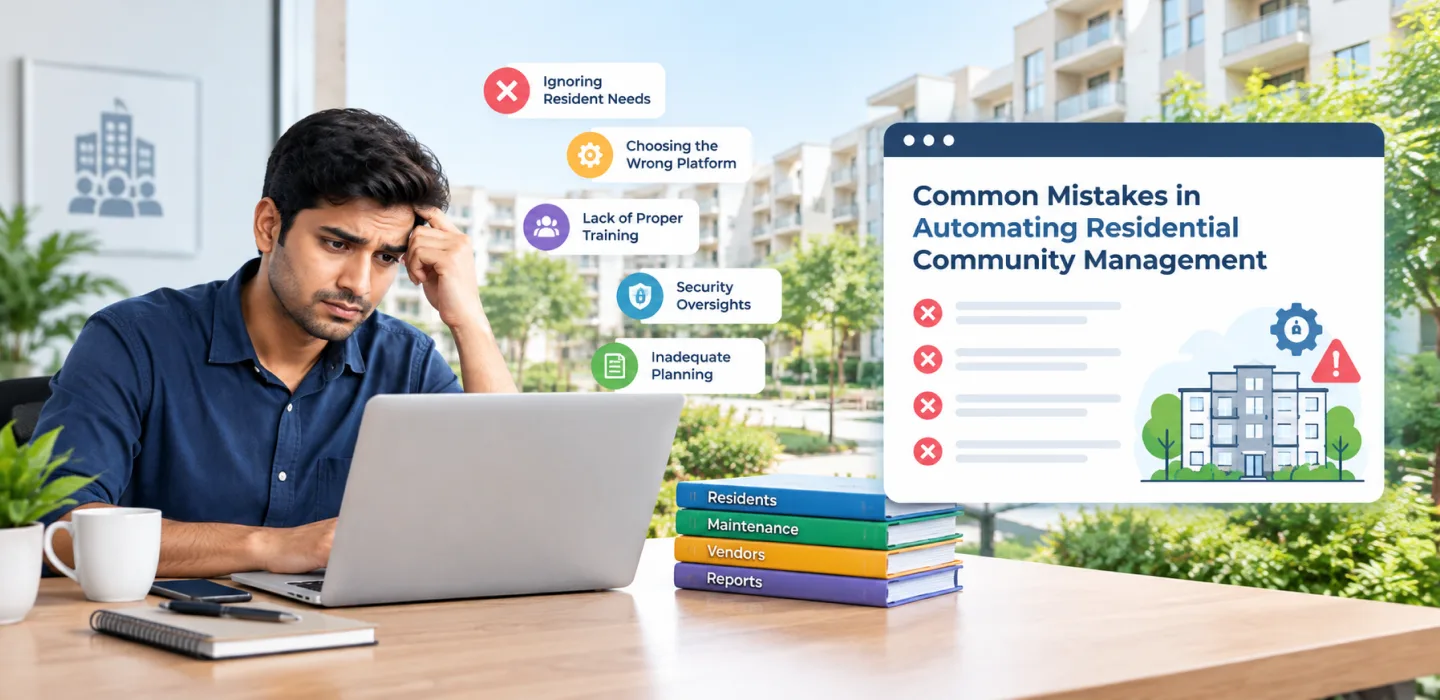
Common Mistakes in Automating Residential Community Management
By MyKutir Editorial Team — 2026-09-24
Discover the common pitfalls in automating residential community management and how to effectively overcome them.
Across India, residential community management is witnessing a transformative shift towards automation, driven by the need for enhanced efficiency, better accuracy, and improved resident satisfaction. Communities are increasingly adopting digital solutions to streamline operations, reduce manual errors, and enhance communication. The advent of platforms like MyKutir has made it feasible for societies to embrace this change, offering features that address varied managerial needs, from accounting and maintenance to communication and security.
Automation in residential community management is becoming indispensable as the complexity of managing these communities grows. With residents expecting more transparency and quicker responses to their needs, manual processes often fall short. Automating tasks such as billing, maintenance requests, and visitor management can not only save time but also significantly enhance the accuracy of these operations, reducing discrepancies and increasing trust within the community.
Moreover, automation allows for better data management and analytics. By collecting and analyzing data systematically, community managers can gain insights into operational efficiencies and areas for improvement. This data-driven approach helps in making informed decisions that align with the community's needs and expectations.
Platforms like MyKutir play a pivotal role in this transition by offering customized solutions that cater to the specific needs of housing societies. These platforms often include modules for financial management, communication, facility booking, and security management, thereby providing a comprehensive toolset for managers. By integrating these various aspects of community management into a single platform, systems like MyKutir simplify the process, making it more manageable and less prone to errors.
Mistake 1: Inadequate Planning and Goal Setting
A frequent pitfall in the journey towards automating residential community management is inadequate planning and goal setting. Before diving into automation, it is crucial to establish clear objectives and a strategic plan that outlines the community's unique needs and how automation will address them. Without a well-defined plan, communities may find themselves investing in technology that does not align with their goals, leading to wasted resources and frustration.
Consider the scenario where a housing society decides to automate its visitor management system without assessing its current challenges or future needs. The result could be a system that is either too complex for its purposes or too simplistic to handle the community's security requirements. This mismatch can lead to frustration among residents and management, ultimately rendering the investment ineffective.
To avoid such outcomes, communities should start by conducting a thorough assessment of their current processes and identifying areas where automation can provide the most significant improvements. Engaging stakeholders, including residents, management, and vendors, in the planning phase ensures that the chosen solutions address the real issues faced by the community.
A successful plan will also include a timeline for implementation and clearly defined success metrics. These metrics should be aligned with the community's overall goals, allowing for ongoing evaluation and adjustment. By setting realistic expectations and having a clear roadmap, communities can better manage the transition and maximize the benefits of automation.
Mistake 2: Ignoring User Training and Change Management
Another common mistake in automating residential community management is neglecting the critical aspect of user training and change management. Introducing new technology requires not only an understanding of its functionalities but also an adjustment in workflows and habits. Without proper training, both management and residents might find it challenging to adapt, leading to low adoption rates and resistance to change.
Change management involves preparing the community for the transition, addressing concerns, and communicating the benefits of automation. It's essential to recognize that people tend to resist change, especially if they perceive it as a threat to their current comfort zones. Therefore, implementing a structured change management process is crucial to ease the transition.
Training sessions should be comprehensive and user-centric, offering hands-on experiences that enable users to get comfortable with the new system. Providing ongoing support and creating a feedback loop where users can voice their concerns and suggestions can help in fine-tuning the implementation process.
For example, if a community adopts a new digital platform like MyKutir, management should organize workshops and provide resources such as user manuals and FAQs to assist residents and staff. This support not only helps in using the system effectively but also fosters a sense of inclusion, which is vital for successful adoption.
Mistake 3: Underestimating the Importance of Data Management
Data management plays an integral role in the success of any automated system. Many communities underestimate the importance of maintaining high-quality data, which can lead to inefficiencies and errors that negate the benefits of automation. Poor data quality—such as outdated, inaccurate, or inconsistent entries—can severely impact automated processes, leading to faulty outputs and decision-making.
Effective data management starts with establishing clear guidelines for data entry and maintenance. Communities must ensure that data is consistently updated and verified to maintain its accuracy and relevance. Implementing regular audits and using tools that provide data validation checks can help in maintaining high data standards.
An illustrative scenario could involve a community that automates its financial reporting. If the input data is not managed properly—such as incorrect billing information or unrecorded maintenance fees—the reports generated by the system will be flawed, leading to discrepancies in financial statements and possible mistrust among residents.
Therefore, communities should also focus on educating staff about the importance of data management and implementing policies that promote accurate data entry. By prioritizing data quality, communities can enhance the reliability of automated systems and ensure they deliver the intended benefits.
Mistake 4: Choosing the Wrong Technology
Selecting the wrong technology for automating residential community management can result in inefficiencies and increased costs, undermining the very purpose of automation. With numerous options available, it is crucial for communities to carefully evaluate their needs and choose a solution that aligns with those requirements.
Communities should start by listing their priorities and identifying features that are essential. For example, a community with frequent visitor turnover might prioritize a robust visitor management system, while another with extensive facilities may need a platform that excels in maintenance scheduling.
MyKutir, for instance, offers a range of features tailored to different aspects of community management, such as accounting, maintenance, and security. By evaluating platforms based on these functionalities, communities can select a solution that fits their specific needs.
| Feature | MyKutir | Manual Process |
|---|---|---|
| Visitor Management | Real-time tracking, pre-approval system | Manual logs, delayed information |
| Accounting | Automated billing, expense tracking | Spreadsheet-based, prone to errors |
| Maintenance Scheduling | Centralized requests, reminders | Manual scheduling, missed requests |
Another critical factor is the ease of integration with existing systems. The chosen technology should not only meet current needs but also be scalable and adaptable to future requirements. Requesting demos and seeking feedback from other users can provide insights into the platform's usability and effectiveness.
Mistake 5: Failing to Integrate with Existing Systems
For automation to be truly effective, it must integrate seamlessly with the existing systems and processes within the community. Failure to achieve such integration can lead to isolated systems that do not communicate with each other, resulting in inefficiencies and data silos.
Common challenges include compatibility issues, data migration difficulties, and resistance to changing established workflows. To address these challenges, it's important for communities to assess their current systems and identify key areas where integration is necessary.
For instance, if a community uses a separate accounting system, it's essential that the new automation platform can sync with it to ensure smooth financial operations. MyKutir, with its flexible architecture, offers integration capabilities that can link with popular financial and communication software, ensuring a cohesive system across all functions.
Communities should work closely with technology providers to map out integration requirements and address potential obstacles during the planning stage. This proactive approach helps in creating a unified system that enhances operational efficiency and minimizes manual intervention.
Case Study: Successful Automation in a Residential Community
Let’s consider the scenario of "Green Meadows Society," a fictional yet illustrative example of a residential community that successfully automated its management processes. Green Meadows identified several challenges, including time-consuming manual billing, uncoordinated maintenance requests, and inefficient communication.
To address these, they developed a comprehensive plan that involved all stakeholders in identifying key pain points and desired outcomes. They chose MyKutir as their automation platform due to its robust features and ease of integration with their existing systems. A detailed implementation roadmap was laid out, with specific goals and timelines.
The community prioritized training sessions for both staff and residents, ensuring everyone understood how to use the new tools effectively. Additionally, they established a committee to oversee the transition, troubleshoot issues, and gather feedback. This strategic approach resulted in a smooth transition to the new system.
Post-implementation, Green Meadows witnessed significant improvements in operational efficiency. Billing processes became faster and more accurate, maintenance requests were tracked more effectively, and communication within the community improved significantly. By avoiding common pitfalls and focusing on strategic planning and user training, Green Meadows set a benchmark for successful automation in residential community management.
Best Practices to Avoid Common Mistakes
Adopting best practices can help communities avoid common mistakes in automating their management processes. Here are some actionable strategies:
- Conduct a Needs Assessment: Begin by evaluating the current state of community management. Identify areas where automation would yield the most benefits, and prioritize these in the implementation plan.
- Engage Stakeholders: Involve residents, management, and other stakeholders in the planning process. Their input can provide valuable insights and foster buy-in, smoothing the transition to automation.
- Set Clear Objectives: Define success metrics and ensure they align with the community’s goals. Regularly assess these metrics to track progress and make necessary adjustments.
- Focus on Training: Provide comprehensive training for staff and residents. Utilize workshops, user manuals, and support channels to facilitate learning and adaptation.
- Prioritize Data Management: Implement policies for consistent and accurate data entry. Regularly audit data quality to maintain system integrity.
- Evaluate Technology Carefully: Choose technology solutions that align with the community's needs and allow for future scalability. Request demos and gather user feedback to ensure usability and effectiveness.
- Ensure System Integration: Work with vendors to map out integration requirements and overcome potential barriers, ensuring a seamless transition between new and existing systems.
Conclusion: Embracing Automation for Better Management
In conclusion, while automation offers numerous benefits for residential community management, it also comes with challenges that must be navigated carefully. By understanding common pitfalls and adopting best practices, communities can leverage automation to enhance efficiency, accuracy, and resident satisfaction.
Platforms like MyKutir provide valuable tools to aid this transition, offering comprehensive solutions that cater to diverse management needs. However, the key to successful automation lies not just in choosing the right technology but also in effective planning, stakeholder engagement, and continuous improvement.
As residential communities continue to grow and evolve, embracing automation thoughtfully will be vital to meeting the increasing demands and expectations of residents. By doing so, communities can ensure a more organized, efficient, and harmonious living environment for all residents.
Frequently Asked Questions
What are the benefits of automating residential community management?
Automating residential community management offers several benefits, such as increased efficiency, improved accuracy, and enhanced resident satisfaction. Automation reduces the burden of manual tasks, allowing for quicker and more precise operations such as billing, visitor management, and maintenance scheduling. It also facilitates better data management, providing insights through analytics that help communities make informed decisions. Moreover, automation improves communication within the community, ensuring that residents' needs are met promptly and effectively. Overall, automation leads to a more streamlined and efficient management process that enhances the quality of life for residents.
How can inadequate planning affect automation efforts?
Inadequate planning can significantly hinder the success of automation efforts in residential community management. Without a clear plan, communities may choose technology solutions that do not align with their specific needs, leading to inefficiencies and increased frustration. A lack of planning can also result in unclear goals and metrics, making it difficult to measure the success of the automation process. Furthermore, inadequate planning can lead to a lack of stakeholder engagement, resulting in resistance and low adoption rates. Therefore, it is crucial for communities to conduct a thorough needs assessment, engage stakeholders, and define clear objectives before implementing automation.
Why is user training important in implementing automation?
User training is an essential component of implementing automation, as it ensures that both staff and residents can effectively use the new systems. Without proper training, users may struggle to adapt to the new technology, leading to low adoption rates and resistance to change. Training helps users understand the functionalities of the system, how to navigate it, and how it benefits the community as a whole. Additionally, training fosters a sense of inclusion and engagement, as residents and staff feel more confident and comfortable with the technology. Providing ongoing support and creating feedback mechanisms can further enhance user training and ensure successful implementation.
What role does data management play in automation?
Data management is a critical component of automation, as it directly impacts the accuracy and reliability of automated processes. High-quality data is essential for generating accurate outputs and making informed decisions. Poor data quality, such as outdated or inconsistent entries, can lead to errors and inefficiencies that undermine the benefits of automation. Therefore, communities must prioritize data management by establishing clear guidelines for data entry and maintenance, conducting regular audits, and using tools that provide data validation checks. By maintaining high data standards, communities can ensure that their automated systems function effectively and provide the intended benefits.
How can communities choose the right technology for automation?
Choosing the right technology for automation requires careful evaluation of the community’s needs and priorities. Communities should start by identifying their key pain points and the features required to address them. Platforms like MyKutir offer a range of functionalities tailored to different aspects of community management, such as accounting, maintenance, and security. Communities should evaluate platforms based on these functionalities and ensure that they align with their specific requirements. Additionally, it is important to consider factors such as ease of integration, scalability, and user feedback. Requesting demos and consulting with other users can provide valuable insights into the platform’s usability and effectiveness.
What are some examples of successful automation in residential communities?
Successful automation in residential communities can be illustrated through case studies such as the fictional "Green Meadows Society." By developing a comprehensive plan, engaging stakeholders, and prioritizing training, Green Meadows successfully automated its management processes with MyKutir. They witnessed significant improvements in operational efficiency, such as faster and more accurate billing, effective tracking of maintenance requests, and improved communication within the community. By avoiding common pitfalls and focusing on strategic planning and user training, Green Meadows set a benchmark for successful automation in residential community management.
What are best practices to ensure successful automation?
To ensure successful automation in residential community management, communities should adopt best practices such as conducting a needs assessment, engaging stakeholders, and setting clear objectives. Providing comprehensive user training and prioritizing data management are also crucial for effective implementation. Communities should carefully evaluate technology solutions to ensure they align with their needs and allow for future scalability. Ensuring seamless integration with existing systems and processes is also vital for maximizing the benefits of automation. By following these strategies, communities can avoid common mistakes and achieve a more efficient and harmonious living environment.
Key Takeaways
- Automation enhances efficiency and accuracy in residential community management, benefiting both residents and management.
- Inadequate planning and goal setting can hinder the success of automation efforts, leading to mismatched solutions and wasted resources.
- User training and change management are crucial for successful technology adoption, ensuring high adoption rates and minimal resistance.
- Data management is essential for maintaining the accuracy and reliability of automated processes, necessitating consistent data quality.
- Choosing the right technology involves evaluating community needs and ensuring integration with existing systems for effective automation.
- Case studies like Green Meadows demonstrate the importance of strategic planning and stakeholder engagement for successful automation.
- Adopting best practices, including needs assessments and ongoing evaluations, can help communities avoid common pitfalls and optimize automation benefits.