AI-Enhanced Visitor Management in Indian Housing Societies: An Expert Opinion
By MyKutir Editorial Team — 2026-08-27
Discover expert insights on implementing AI-enhanced visitor management in Indian housing societies, focusing on benefits and best practices.
In the context of Indian housing societies, visitor management is a crucial element of ensuring both security and convenience. Traditional methods, often involving manual logbooks or simple intercom systems, have been the norm for decades. However, these approaches come with several issues such as human error, lack of real-time data, and inefficiencies. In recent years, the introduction of AI-enhanced visitor management systems has promised to revolutionize the way housing societies handle visitors by incorporating advanced technologies for more secure, efficient, and seamless operations.
AI-enhanced visitor management involves the integration of artificial intelligence technologies to automate and improve the process of managing visitors within a housing society. This includes features like automated access control, real-time visitor tracking, and advanced data analytics. The significance of this technology lies in its ability to reduce manual errors, enhance security through real-time monitoring, and provide a better overall experience for both residents and visitors. As Indian societies grow in complexity and size, the need for efficient visitor management becomes paramount, making AI an invaluable tool in meeting these demands.
How AI Transforms Visitor Management
AI technologies transform visitor management by introducing a range of features that automate and streamline processes. One of the key improvements AI brings is in the realm of automated access control. This involves using technologies like facial recognition and machine learning to allow or deny access to visitors, ensuring that only authorized individuals can enter the premises. For instance, AI-driven cameras can identify and authenticate visitors in real-time, reducing the need for manual checks by security personnel.
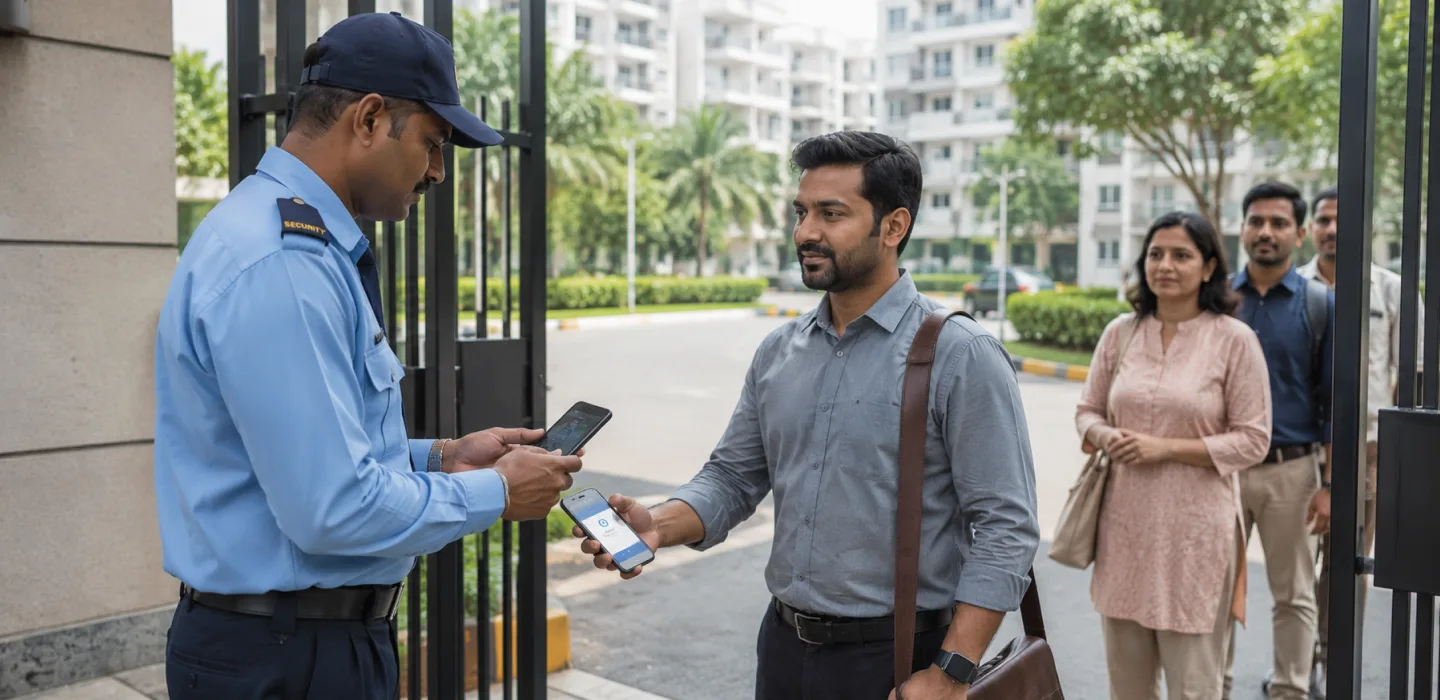
AI also enhances security features through predictive analytics and anomaly detection. By analyzing patterns in visitor data, AI systems can predict and alert security staff to potential threats. For example, if an unusual number of visitors are detected at a particular time, the system can flag this as a possible security concern. Furthermore, AI-assisted visitor registration streamlines the check-in process by allowing visitors to pre-register their details and receive digital badges or QR codes for swift entry, reducing wait times and improving accuracy.
Data analytics driven by AI can provide housing societies with valuable insights into visitor patterns and behaviors. This information can be used to optimize staffing levels, enhance resource allocation, and improve overall security measures. Ultimately, AI transforms visitor management from a reactive to a proactive approach, delivering a superior experience for both residents and visitors while significantly enhancing security protocols.
Implementing AI in Housing Society Visitor Management
Implementing AI in housing society visitor management requires a multidisciplinary approach, combining technology, infrastructure, and human resources. The first step involves assessing the current visitor management system to identify gaps and areas for improvement. This assessment helps in determining the specific AI capabilities needed, such as facial recognition technology or data analytics platforms.
The next step is to build or upgrade the technological infrastructure to support AI applications. This may include installing AI-driven cameras, updating existing software, and ensuring robust internet connectivity. Integration with existing systems is crucial to ensure a seamless transition. It's important to choose AI solutions that can easily integrate with current security systems and databases to avoid data silos and operational disruptions.
Staff training is another critical component of AI implementation. Security personnel and society management must be trained to use new technologies effectively. This includes understanding how to interpret AI data, respond to alerts, and manage new access control mechanisms. Training sessions should be comprehensive and ongoing, as AI technologies continually evolve.
Additionally, communication with residents is essential to ensure transparency and address any concerns regarding privacy and data security. Informing residents about the benefits and operations of AI-enhanced visitor management can increase acceptance and cooperation. By following these practical steps, housing societies can successfully implement AI into their visitor management systems, leading to enhanced security and efficiency.
Benefits of AI-Driven Visitor Management
The adoption of AI-driven visitor management systems presents numerous benefits for housing societies. One of the most significant advantages is enhanced security. AI systems can provide continuous, real-time surveillance, identifying unauthorized visitors and potential threats instantly. This proactive approach ensures a safer environment for residents by effectively mitigating risks before they escalate.
Efficiency is another notable benefit. Traditional visitor management methods often involve time-consuming processes such as filling out logbooks or manually verifying identity documents. AI automates these tasks, allowing for faster visitor processing and reducing wait times at entry points. Features like pre-registration and digital badges streamline the check-in process, resulting in a more efficient operation that can handle higher volumes of visitors without compromising security.
AI-driven systems also improve resident satisfaction. By reducing the time and complexity involved in managing visitors, residents experience a more pleasant and hassle-free environment. The ability to track and manage their visitors through digital platforms provides an added layer of convenience, as residents can authorize entry, schedule visits, and receive notifications in real-time.
Moreover, AI's data analytics capabilities provide housing societies with valuable insights into visitor trends and behaviors. These insights can inform decision-making around security measures, resource allocation, and operational adjustments, further enhancing the efficiency and effectiveness of management practices.
Challenges and Solutions in AI Integration
While AI-enhanced visitor management offers numerous benefits, its integration is not without challenges. One of the primary concerns is data privacy. AI systems collect and process large amounts of personal data, raising questions about how this data is stored, used, and protected. To address these concerns, societies must implement robust data protection protocols, including encryption and anonymization of data, and ensure compliance with relevant data protection regulations in India.
Technical issues present another challenge in AI integration. Housing societies may face difficulties in integrating AI solutions with existing systems or may encounter compatibility issues with different hardware and software. Selecting versatile AI solutions that are designed for easy integration can mitigate these challenges. Additionally, working with experienced vendors who offer ongoing technical support can help address technical issues as they arise.
Another challenge is the cost associated with deploying AI technologies. While AI solutions can lead to long-term cost savings, the initial investment can be significant. Societies can explore various funding options such as grants, subsidies, or phased implementation to manage costs effectively.
Lastly, there is the challenge of resistance to change. Stakeholders, including residents and staff, may be hesitant to adopt new technologies due to unfamiliarity or perceived complexity. Transparent communication, education, and demonstration of the benefits can help build trust and acceptance among all stakeholders.
Comparison: AI-Powered vs Traditional Visitor Management
When evaluating visitor management systems, it's important to compare AI-powered solutions with traditional methods. Key differences arise in areas such as efficiency, security, cost, and user experience. The table below summarizes these comparisons:
| Feature | AI-Powered | Traditional |
|---|---|---|
| Efficiency | Automated processes, reduced wait times, scalable | Manual logging, longer wait times, limited scalability |
| Security | Real-time surveillance, predictive analytics, anomaly detection | Basic manual checks, less preventive measures |
| Cost | Higher initial cost, lower long-term operational costs | Lower initial cost, higher long-term manual labor costs |
| User Experience | User-friendly digital interfaces, convenient for residents and visitors | Paper-based, less interactive, cumbersome |
From the table, it's evident that AI-powered systems offer superior efficiency and security compared to traditional methods. Although the initial investment may be higher, the long-term benefits in terms of cost savings and enhanced user experience make AI a compelling choice for modern housing societies.
Success Story: A Case Study of AI Implementation
Consider a hypothetical scenario of Green View Residency, a mid-sized housing society in Bangalore, which decided to overhaul its visitor management system by implementing AI technologies. The society faced challenges with its existing manual system, including long wait times for visitor entry, frequent errors in visitor logs, and limited security measures.
Green View Residency began its journey by conducting a thorough assessment of its current visitor management practices. The management identified key areas for improvement and chose to implement an AI-powered visitor management system that offered features like face-recognition attendance, digital visitor badges, and predictive security analytics.
The implementation process involved upgrading their technological infrastructure, including installing AI-driven cameras and software. The society worked closely with a technology provider to ensure smooth integration with their existing security systems and provided training sessions for their security staff to familiarize them with the new platform.
Despite initial resistance from some residents and staff, the management engaged in comprehensive communication efforts to highlight the benefits and address concerns regarding privacy and data security. Over time, stakeholders began to appreciate the convenience and security offered by the new system.
The outcomes were impressive. Green View Residency reported a significant reduction in visitor wait times, improved accuracy in visitor logs, and enhanced overall security. The AI system also provided valuable insights into visitor patterns, enabling the management to optimize their staffing and security measures further. By adopting AI technologies, Green View Residency successfully transformed its visitor management processes, setting an example for other housing societies to follow.
Best Practices for AI-Driven Visitor Management
Implementing and maintaining AI-driven visitor management systems requires adherence to best practices to ensure optimal performance and security. Regular updates are critical to keep the AI software up to date with the latest features and security patches. Societies should work closely with their technology providers to schedule updates and conduct periodic audits of their systems.
Establishing robust security protocols is essential to protect sensitive data and maintain residents' trust. This includes using encryption for data transmission, implementing access controls, and conducting regular security assessments. Compliance with data protection regulations is also crucial, requiring societies to stay informed about legal requirements and ensure their systems align with these standards.
Effective communication with residents is another best practice. Societies should keep residents informed about the AI systems in place, their benefits, and any updates or changes. This transparency helps build trust and encourages residents to engage with the technology positively.
Training is an ongoing process. Security personnel and administrative staff should receive regular training to stay informed about new features and best practices. This training should also cover how to interpret AI-generated data, respond to alerts, and troubleshoot common issues.
By following these best practices, housing societies can maximize the benefits of AI-driven visitor management systems, ensuring they remain effective, secure, and user-friendly over the long term.
Conclusion and Future Outlook
The integration of AI-enhanced visitor management systems in Indian housing societies marks a significant advancement in ensuring security, efficiency, and satisfaction for residents. Throughout this article, we have explored how AI transforms visitor management by automating processes, enhancing security features, and providing invaluable data insights. The benefits of AI-driven systems are evident in increased efficiency, improved security, and a superior user experience.
However, the journey towards successful AI integration is not without its challenges. By understanding and addressing issues such as data privacy, technical complexities, and resistance to change, housing societies can effectively navigate the transition to AI-powered systems. The hypothetical case study of Green View Residency illustrates how these challenges can be overcome to achieve impressive results.
Looking to the future, AI technologies will continue to evolve, offering even more sophisticated solutions for visitor management. Emerging technologies such as machine learning, predictive analytics, and IoT integrations hold the potential to further enhance the capabilities of AI systems, providing housing societies with more robust security measures and efficient operational processes.
In conclusion, AI-enhanced visitor management systems represent a promising future for Indian housing societies. By embracing these technologies, societies can ensure a safer, more efficient, and satisfying living environment for residents, setting the stage for continued advancements and long-term benefits.
FAQ
What is AI-enhanced visitor management?
AI-enhanced visitor management integrates artificial intelligence technologies into the process of managing visitors within a housing society. These systems automate tasks like visitor registration, access control, and surveillance, using technologies such as facial recognition and data analytics to enhance security and efficiency. By providing real-time data and predictive insights, AI-enhanced systems offer a proactive approach to visitor management, improving the overall experience for both residents and visitors.
How does AI improve security in housing societies?
AI improves security in housing societies by enabling real-time monitoring and automating access control. AI-driven cameras equipped with facial recognition can accurately identify individuals, ensuring only authorized visitors gain entry. Predictive analytics further bolster security by analyzing visitor patterns to detect anomalies and potential threats, allowing for swift intervention. These capabilities transform security measures from reactive to proactive, significantly enhancing the safety of housing societies.
What steps are needed to implement AI in visitor management?
Implementing AI in visitor management involves several key steps. First, conduct a thorough assessment of the current visitor management system to identify areas for improvement. Next, upgrade technological infrastructure to support AI applications, such as installing AI-driven cameras and software. Integration with existing systems is crucial for a smooth transition. Staff training is essential to ensure effective use of the new technologies. Lastly, communicate with residents to address any privacy concerns and highlight the benefits of AI-enhanced visitor management.
What are the benefits of AI-driven visitor management systems?
AI-driven visitor management systems offer numerous benefits, including enhanced security through real-time surveillance and predictive analytics. They improve efficiency by automating processes and reducing wait times for visitors. Residents enjoy increased convenience with digital interfaces and real-time notifications. AI systems also provide valuable data insights that inform decision-making and optimize resource allocation. Overall, AI-driven systems deliver a superior experience for residents and visitors while significantly enhancing security protocols.
What challenges might societies face in AI integration?
Societies may face several challenges when integrating AI, including data privacy concerns, technical issues, and the cost of deployment. Ensuring robust data protection measures and compliance with regulations is crucial to address privacy concerns. Technical challenges can be mitigated by selecting versatile AI solutions and working with experienced vendors. The initial cost can be managed through phased implementation or exploring funding options. Resistance to change can be addressed through transparent communication, education, and demonstration of benefits.
How does AI visitor management compare to traditional methods?
AI visitor management offers significant advantages over traditional methods. AI systems automate processes, enhancing efficiency and reducing wait times. They provide real-time surveillance and advanced security features, improving safety. While AI solutions may have higher initial costs, they lead to long-term savings in operational costs. User experience is also superior, with digital interfaces and convenience for residents and visitors. In contrast, traditional methods are manual, less efficient, and offer limited security enhancements.
What are the best practices for maintaining AI-driven systems?
Maintaining AI-driven systems involves several best practices. Regular updates to AI software ensure access to the latest features and security patches. Establish robust security protocols to protect sensitive data and comply with regulations. Communication with residents is essential to build trust and transparency. Continuous training for staff ensures they remain informed about new features and best practices. By following these practices, societies can maximize the benefits of AI-driven systems, ensuring they remain effective and secure over time.
What is the future of AI in housing society management?
The future of AI in housing society management is promising, with continued advancements expected in machine learning, predictive analytics, and IoT integrations. These technologies will offer even more sophisticated solutions for visitor management, further enhancing security and operational efficiency. As societies increasingly embrace AI, they can expect safer, more efficient, and satisfying living environments for residents. This ongoing evolution of AI technologies will play a crucial role in transforming the landscape of housing society management in India.
Key Takeaways
- AI-enhanced visitor management systems automate and improve the processes of managing visitors in housing societies, offering enhanced security and efficiency.
- AI technologies such as facial recognition, predictive analytics, and anomaly detection transform visitor management from a reactive to a proactive approach.
- Implementing AI involves upgrading technological infrastructure, integrating with existing systems, staff training, and clear communication with residents.
- AI-driven systems provide significant benefits, including increased security, efficiency, resident satisfaction, and valuable data insights.
- Challenges in AI integration include data privacy concerns, technical issues, and resistance to change, but these can be addressed through best practices.
- AI-powered visitor management offers superior efficiency, security, and user experience compared to traditional methods.
- Following best practices ensures the effective and secure maintenance of AI-driven systems, maximizing their long-term benefits.
- AI technologies will continue to evolve, providing more advanced solutions for visitor management and transforming Indian housing societies.